
Bee Suit vs Bee Jacket: Which One Should You Actually Buy?
Full suits cover you ankle to veil; jackets stop at the hips and go on in seconds. Which one you need comes down to your bees, your climate and your experience — here is the decision, with a side-by-side comparison.

The bee suit vs bee jacket decision comes down to one thing: whether you need your legs covered. Buy a full bee suit if you are new to beekeeping, allergic to stings, running more than two or three hives, or working colonies that get defensive. Buy a bee jacket if you are experienced, your bees are calm, your inspections are short, and you want something you can pull on in twenty seconds. Most beekeepers who stay in the hobby past their second season end up owning both, because the two garments solve different problems.
Key Takeaways
- A full suit covers you from ankle to veil in one piece. A bee jacket covers your torso, arms and head, and stops at the hips.
- The jacket's weak point is the hem. Bend over a hive and it rides up — which is why the elastic drawcord matters more than the fabric.
- A full suit is not automatically safer. A badly fitted full suit worn tight against the skin gives you less real protection than a loose jacket with sealed cuffs.
- Jackets are cooler and faster, but they leave your legs unprotected. Bees go for ankles.
- For most beekeepers, the honest answer is a full suit first, a jacket second — not the other way round.
The short answer
The decision is not really about protection. Both garments protect your head, face, neck, torso and arms — the areas where a sting does the most damage and causes the most panic. The difference is your legs, and how much that matters depends on three things: how defensive your bees are, how long you stand at an open hive, and how comfortable you are being stung.
A new beekeeper cannot answer those three questions yet. That is the real argument for starting with a full suit. Not because a jacket is dangerous, but because confidence is what keeps your hands steady, and steady hands are what keep a colony calm.
Once you have a season behind you and you know your bees, a jacket becomes a genuinely useful tool rather than a shortcut.
What a full bee suit actually is
A full suit is a one-piece coverall with an attached or zip-on veil. You step into it, zip up the front, and everything between your ankles and the top of your head is inside one continuous barrier.
That continuity is the point. There is no waistband for a bee to crawl under, no gap that opens when you reach across a hive body, and no moment where your shirt pulls out of your trousers while you are lifting a full super.
Where the protection comes from
Fabric thickness matters far less than people assume. A honey bee's sting has a fixed length. If the fabric sits far enough from your skin, the sting cannot reach you regardless of how thin the material is.
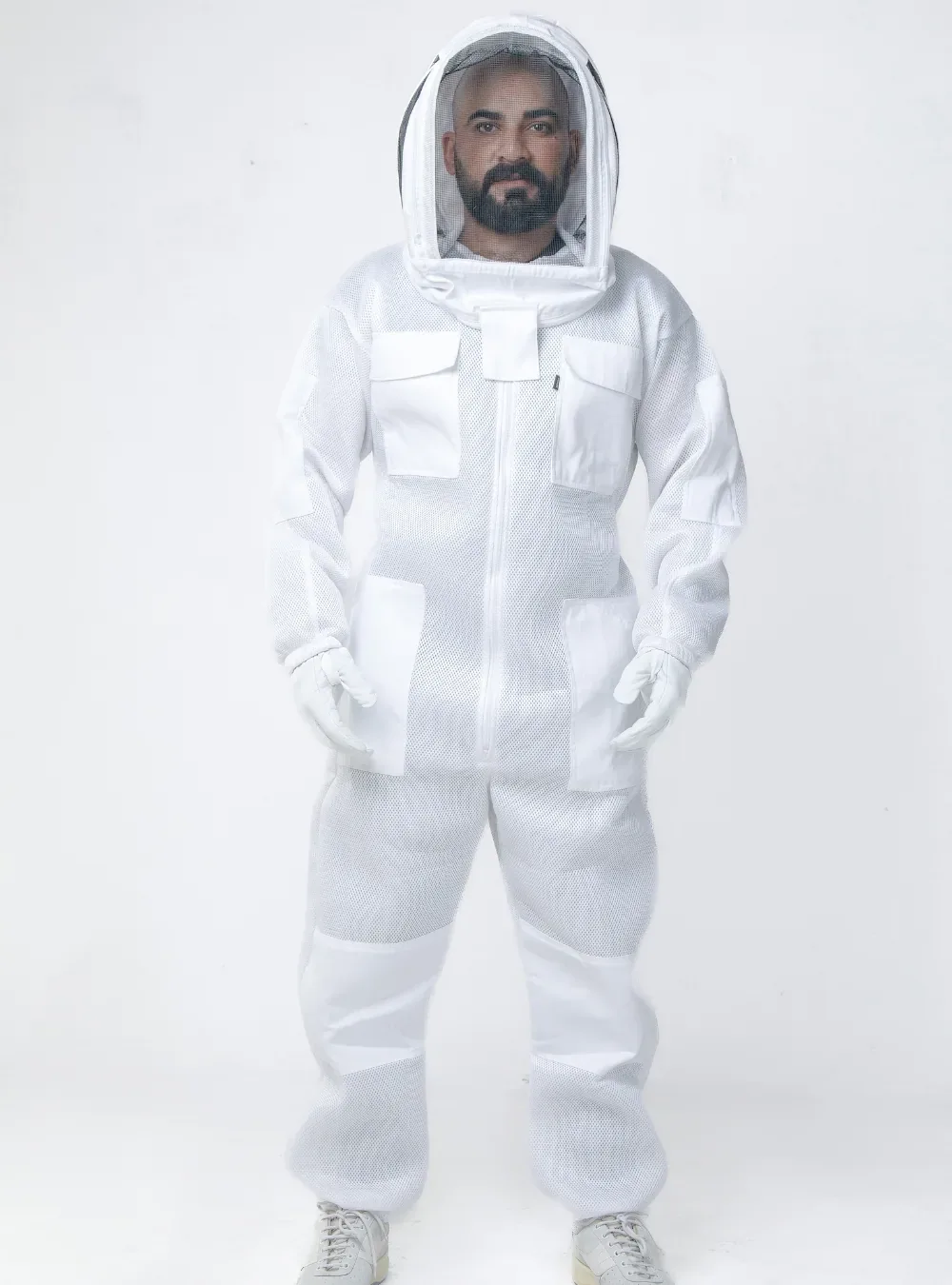
This is why a three-layer ventilated mesh suit protects better than a single layer of heavy cotton pulled tight across your shoulders. The mesh holds a standoff gap — an air space between the outer surface and your body — and that gap does the work.
It is also why the advice to buy a size up is not laziness. Slack fabric cannot be pressed against skin. Our own size guide walks through the measurements that matter, and the short version is: measure over the clothes you actually wear at the hive, not over a t-shirt.
Cotton suits work on a different principle. They rely on a tight weave and enough thickness that a sting embeds in the fibers before it reaches you. They protect well, they are quieter in wind, and they cost less — but they hold heat, and in a hot climate that becomes the limiting factor long before protection does.
Tip from the workshop: When you try on a full suit, squat down fully and reach both arms straight above your head. If the crotch pulls or the sleeves lift past your wrists, the suit is too small — no matter what the label says.
What a bee jacket actually is
A bee jacket is the top half of a suit: torso, arms, and a veil, finished at the waist with an elastic or drawcord hem. You pull it over your head or zip it at the front, cinch the hem, and you are ready.
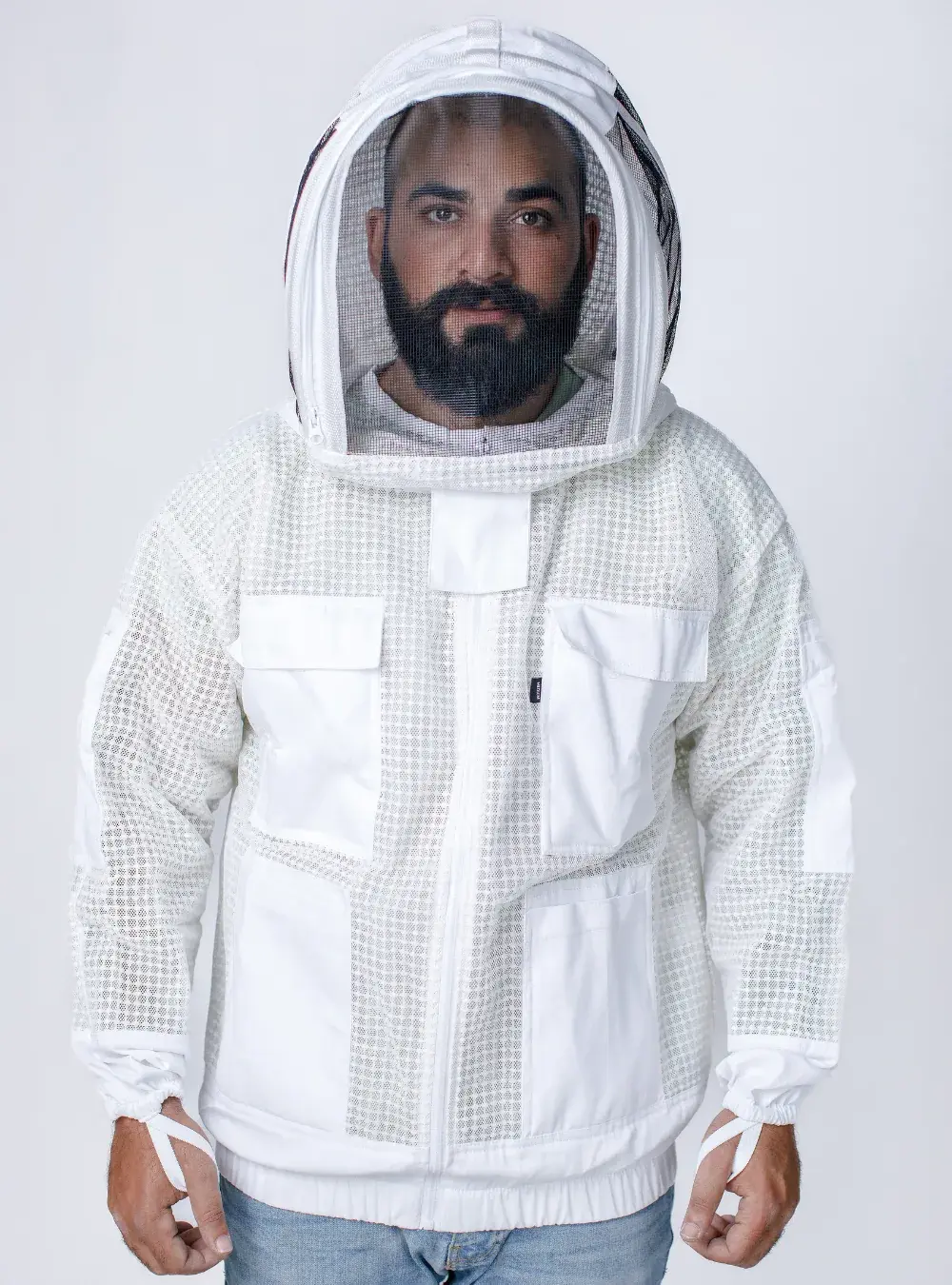
The appeal is obvious. It weighs less, it is far cooler, it packs into a truck box, and you can be wearing it before the smoker is properly lit. For a quick look under the lid to check stores, that speed is not a luxury — it is the difference between checking the hive and telling yourself you will do it tomorrow.
Browse the full range of beekeeping jackets to see how the styles differ in veil type and ventilation.
The hem problem nobody mentions
Here is the thing that buying guides written by people who do not make jackets tend to skip.
When you bend forward over an open hive — which is the position you spend most of an inspection in — a jacket hem rides up your back. A cheap jacket with a thin elastic band will lift two or three inches and expose the small of your back at exactly the moment the colony is most agitated.
A well-made jacket fights this in three ways: a longer cut at the rear than the front, a wide elastic band rather than a thin one, and a drawcord you can actually tighten one-handed while wearing gloves.
When you are comparing jackets, pick them up and look at the hem before you look at anything else. It tells you more about the maker than the fabric does.
There is a simple test you can run in a shop or at your kitchen table. Put the jacket on, cinch the hem, and bend forward as if you were lifting a frame out of a brood box. Reach behind and feel where the hem has moved to. If it has climbed above your waistband, that jacket will do the same thing at the hive, every time, and no amount of care with the smoker will change it.
Bee suit vs bee jacket: side-by-side
| Full bee suit | Bee jacket | |
|---|---|---|
| Coverage | Ankles to veil, one continuous piece | Hips to veil; legs uncovered |
| Main weak point | Ankle cuffs and front zipper | The hem at the waist |
| Heat | Warmer — more fabric, more enclosed | Noticeably cooler; legs vent freely |
| Time to put on | Around a minute, more with boots | Seconds |
| Best for | Beginners, defensive colonies, long inspections, swarm collection | Experienced keepers, calm bees, quick checks, cool weather |
| Worst for | Hot afternoons, five-minute checks | Aggressive colonies, standing in tall grass, anyone nervous |
| Laundry | Bulkier, slower to dry | Easy — fits a normal wash load |
| Storage | Needs hanging space | Folds small |
| Our price range | $70–$160 | $70–$130 |
Those are our own figures, and they show something the general advice misses: the cheapest full suit and the cheapest jacket cost the same. The gap only opens at the top, where a three-layer ventilated suit ($100–$160) has more fabric, more mesh and more construction in it than any jacket does.
So "a jacket is the budget option" is only half true. If your budget is $70, you can have either. The question is still coverage, not cost.
Protection: where each one fails
Both garments fail at their openings, not in the middle of the fabric. Understanding where the openings are tells you which garment suits your situation.
The gap at the waist
This is the jacket's defining limitation, and it is worth being precise about it. The risk is not that bees fly up under the hem in open air — they rarely do. The risk is that you lean over, the hem lifts, and a bee that is already walking on your back finds skin.
You reduce this by tucking the jacket into your trousers, wearing the jacket over a belt, or simply buying a jacket cut long enough that it cannot ride above your waistband.
Ankles and cuffs
A full suit removes the waist problem but introduces two of its own.
Ankles are where most stings happen to suited beekeepers. You stand in grass, bees come up from below, and a loose ankle cuff is an open door. Elastic ankle cuffs help. Boots over the cuff help more. The University of Arkansas beekeeping equipment guide makes the same point about sealing every opening before you approach a colony.
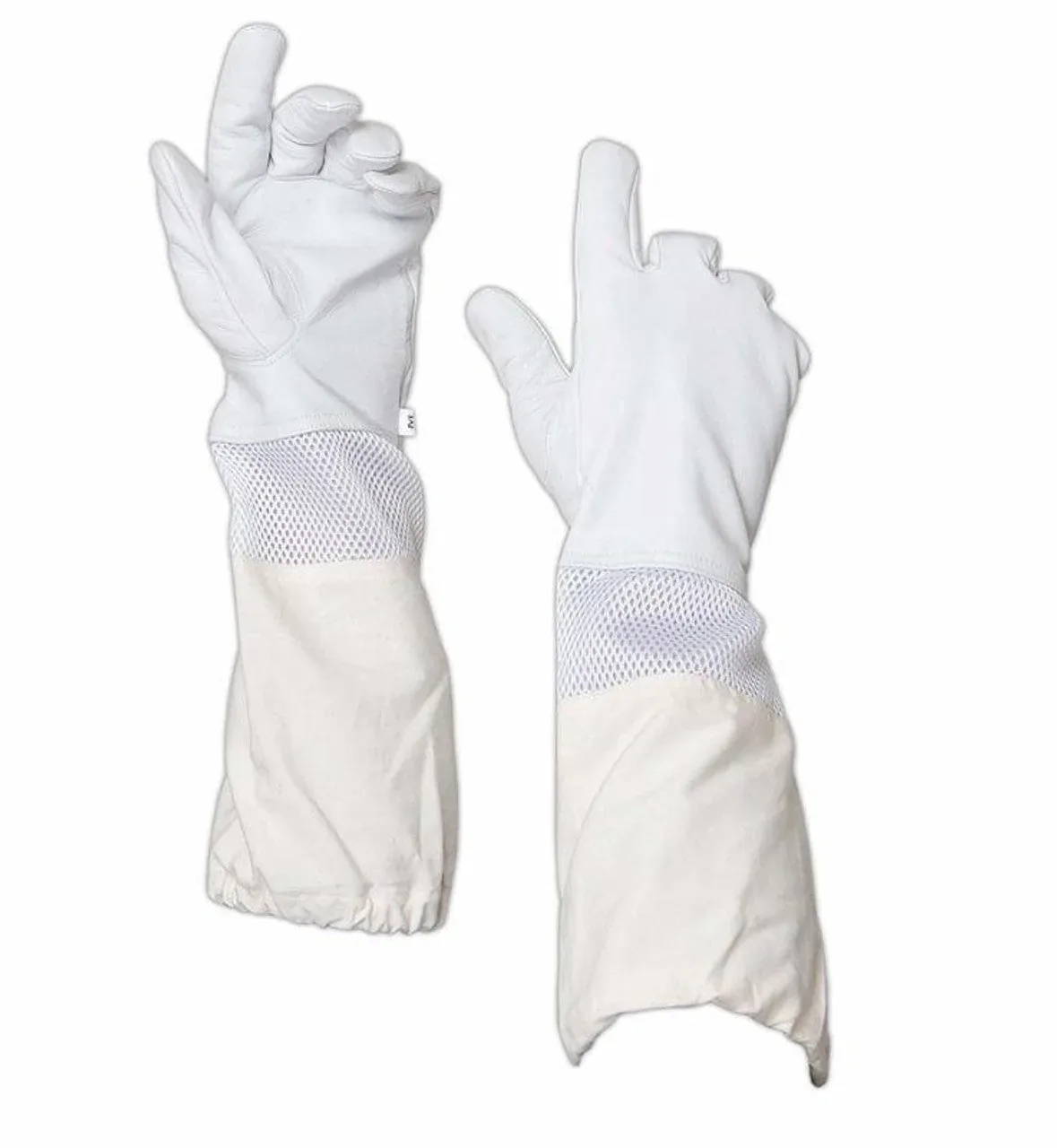
Wrist cuffs matter almost as much. A gauntlet — the extended cuff on a proper beekeeping glove — should overlap the sleeve cuff, not meet it edge to edge. If you can see a line of skin when you extend your arm, that line is where you will be stung. A matched set of beekeeping gloves sized to your sleeve solves this more reliably than tape.
The front zipper is the third opening. A two-way zipper with a fabric storm flap over it is standard on good suits. A single exposed zipper with no flap is a warning sign about the rest of the garment.
Heat and comfort
This is where the decision gets made for most people in the United States, and it is worth being honest about the trade-off rather than pretending there is a free lunch.
A jacket is cooler. Your legs are uncovered, your lower body vents, and you carry roughly half the fabric. On a July afternoon in Texas or Georgia, that is not a small difference.
A full ventilated mesh suit narrows the gap considerably. Three-layer mesh moves air through the standoff gap, and a good one is dramatically cooler than cotton. It will still be warmer than a jacket, because it covers twice the surface area — but the comparison people should be making is ventilated full suit vs jacket, not cotton full suit vs jacket. Those are very different conversations.
If heat is your main concern and you still want full coverage, a ventilated three-layer mesh suit is the honest answer. If you want the coolest thing that still protects your head and torso, it is a jacket.
Warning: Do not solve heat by buying a thinner cotton suit. Thin, tight cotton is the worst combination available — it holds heat and lets stings through where it presses against you.
Cost, and the cost nobody counts
A jacket costs less than a full suit. That is the obvious part.
The part that gets missed is replacement cycle. A jacket gets worn more often, precisely because it is convenient, and the veil takes the wear first. Mesh veils abrade at the shoulder seam and around the zipper track. If you are using a jacket four times a week through the season, you will be looking at the veil long before you look at the body fabric.
A full suit worn twice a week may outlast two jackets. Whether that makes it cheaper depends entirely on how you keep bees.
The other hidden cost is the one people discover late: a suit you find unbearably hot is a suit you stop wearing. The cheapest protective garment in your shed is the one you actually put on.
For reference, our jackets run $70–$130 and our full suits $70–$160, with cotton at the lower end and three-layer ventilated mesh at the top. A veil on its own is $20–$50 and gloves $30–$90, which matters if you are pricing a jacket-and-veil setup against a full suit.
One question worth asking any supplier before you buy: can the veil be replaced on its own? On a garment where the veil wears out first, a maker who sells replacement veils is offering you a second life for the price of a part. A maker who does not is selling you a whole new garment when one zip fails.
Not sure which way to go? If you are buying your first piece of protective gear this season, start with a full suit. You can add a jacket next year once you know your bees. Browse ventilated bee suits or cotton bee suits to compare.
Speed: getting in and out
A jacket goes on in seconds. A full suit does not.
This sounds trivial until you count how it changes your behavior. Beekeepers with jackets check their hives more often. They notice a queenless colony sooner, spot robbing earlier, and catch a failing queen while there is still time to do something about it.
That is a real beekeeping advantage, not just a comfort one. It is the strongest argument for a jacket that exists, and most buying guides do not make it.
The counterweight: speed encourages shortcuts. The beekeeper who pulls on a jacket in fifteen seconds is also the beekeeper who does not bother with gloves, does not light the smoker properly, and opens the hive in a hurry. Bees notice all three.
Who should buy a full suit
Buy a full suit if any of these apply:
- This is your first season. You do not yet know how your colony behaves in a nectar dearth, and you will not learn it well while worrying about your legs.
- You are allergic, or you have not been tested. Full coverage is the correct default until you know.
- You run more than two or three hives. More colonies means more time at open hives and more chance of meeting a bad-tempered one.
- You collect swarms or do removals. Unpredictable bees, awkward positions, and you cannot control the environment.
- Someone else wears your spare gear. A visitor in a full suit is a visitor who stays calm.
- You are buying for a child. Children should have full coverage, in a suit cut for their proportions rather than a scaled-down adult pattern — see our children's beekeeping suits.
Who should buy a jacket
Buy a jacket if most of these apply:
- You have at least a season of experience and you can read a colony's mood before you open it.
- Your bees are calm. You know this because you have worked them without incident through a full year, not because the breeder said so.
- Your inspections are short. Checking stores, adding a super, confirming a queen is laying.
- You keep bees in cooler weather or in the early morning.
- You already own a full suit and want something faster for routine checks.
- You wear sturdy trousers and boots anyway. Denim over boots is not sting-proof, but it is far from nothing.
The case for owning both
Most experienced beekeepers do not choose. They own a full suit for the jobs that warrant it and a jacket for everything else, and the decision gets made at the truck rather than at the checkout.
If your budget allows only one this year, buy the full suit. It can do everything the jacket does, just less comfortably. The reverse is not true — a jacket cannot become a full suit when you meet a hot colony in August.
What to check before you buy either
The suit-versus-jacket question gets all the attention, but the difference between a good garment and a bad one in either category is larger than the difference between the categories. Check these four things.
Veil type
Three shapes dominate, and they fail differently.
- Fencing veil — self-supporting, collapses flat, good all-round visibility. The most popular choice and a sensible default.
- Round veil — held out by a hat brim, excellent airflow, best downward visibility. Bulkier to store.
- Square veil — flat panels, clearest forward view, but the corners can press closer to the face than the other two.
The Mid-Atlantic Apiculture Research and Extension Consortium's equipment guidance describes the same basic families and makes the point that a veil should stand away from the face — which is the criterion that actually matters. If you wear glasses, check the standoff at the front specifically. Browse veils and hats if you are buying one separately.
Zippers
Look for two-way zippers, a storm flap, and metal or heavy-gauge plastic sliders. The veil zipper is the one that fails first because it is opened and closed most often. A jammed veil zipper in the middle of an inspection is more than an inconvenience — it is the reason people take veils off at the wrong moment.
Fabric and mesh construction
For ventilated suits, look at how the three layers are held apart. The middle layer's job is to keep the outer surface away from your skin. If you can squeeze the fabric flat between two fingers with no resistance, the standoff gap is not doing its job.
For cotton, check the weave density and the weight. Heavier is generally better for protection and worse for heat.
Fit
Buy loose. Then check the four positions you actually use: squatting, reaching overhead, leaning forward at the waist, and kneeling. Any of those that exposes skin or pulls fabric tight against your body is a fit failure, and no fabric quality will compensate for it.
Still deciding?
If you are buying one piece of gear this season, buy the full suit — it covers every situation a jacket does. If you already own one and you are tired of putting it on for a five-minute check, the jacket is the upgrade that will get you to the hive more often.
Browse ventilated bee suits → Browse beekeeping jackets →
Not sure about sizing? Our size guide lists the measurements we use, and if you are between sizes on any of them, take the larger one.
Common questions
Is a bee jacket enough for a beginner?
It can be, but it is not the best starting point. A beginner's biggest risk is reacting badly to a sting, dropping a frame and turning a calm inspection into a bad one. Full coverage removes that worry while you learn to read your colonies. Move to a jacket in your second season if you want to.
Can bees sting through a bee jacket?
Yes, in the same circumstances they can sting through a suit: where the fabric is pressed flat against your skin. A jacket stretched tight across your shoulders is vulnerable there; a loose jacket over a shirt is not. The material matters less than the air gap behind it.
Do I need to wear trousers under a bee jacket?
Yes, and sensible ones. Thick, loose trousers tucked into boots are the standard pairing. Shorts with a bee jacket is how people learn why full suits exist. Light-colored trousers are conventional, for the same reasons suits are pale.
Is a full bee suit too hot for summer?
A cotton full suit is hot in summer. A three-layer ventilated mesh full suit is not, in the sense that most beekeepers find it comfortable through a normal inspection. If you are choosing a full suit for a hot climate, ventilated mesh is the version to buy.
Which is better for working aggressive bees?
A full suit, without qualification. Defensive colonies target ankles and the lower body, and they persist. This is the one situation where the jacket's limitation is not theoretical but immediate.
Can I wear a bee jacket over regular clothes?
Yes, that is the normal way to wear one. Wear it over a long-sleeved shirt rather than bare arms, tuck it in or cinch the hem properly, and make sure your glove gauntlets overlap the sleeve cuffs so no skin shows when you extend your arm.
Do I need gloves with a bee suit or jacket?
Gloves are a separate decision, and plenty of experienced beekeepers work bare-handed for dexterity. If you do wear them, the gauntlet must overlap the sleeve cuff. An unmatched glove-and-sleeve combination creates the exact gap the rest of the garment is designed to eliminate.
Written by Alex, Bee suit maker, BEESUITWEAR · United States.
Writes about protective clothing from the workshop where the suits are made.