
Can bees sting through a bee suit?
Yes, where the fabric is touching you. A bee suit does not stop a sting by being tough — it stops one by holding the surface away from your skin.

Yes. A bee can sting through a bee suit anywhere the fabric is pressed against your skin. That is the whole mechanism in one line: a suit does not stop a sting by being too tough to pierce, it stops one by holding its outer surface further from your skin than a sting can reach. Where that gap closes, the suit stops working.
How far a sting through a bee suit actually reaches
A honey bee's sting is a few millimetres long. It is not a needle driven by force. It is a barbed shaft, worked in by a small and specific action, and its reach is short.
So the question is never whether the fabric is strong enough. A single layer of cotton already defeats a bee on its own. The real question: how far the outer surface sits from you, and whether it stays there while you move.
That explains two things at once. A loose cotton suit and a close-fitting one in the same cloth are not equally safe. And a tumble dryer flattens a ventilated suit, which then looks fine and protects badly.
Where a bee can sting through a bee suit
Five places, and they are the same five on every suit ever made.
- Anywhere pulled tight. Across the shoulders when you reach forward. Across the thighs when you kneel. Across the back when you bend over an open box. The fabric is doing nothing there because it is touching you.
- At the cuffs and ankles, if the elastic has gone slack or the sleeve has ridden up above the glove.
- At the veil, where mesh rests on a forehead, a nose or a sweating cheek.
- Through a flattened ventilated layer, where the bonded gap has collapsed and the mesh is now effectively single-layer.
- Through any opening — an unzipped hood, a gaping wrist, a trouser leg over a low shoe.
Why ventilated construction resists a sting through a bee suit
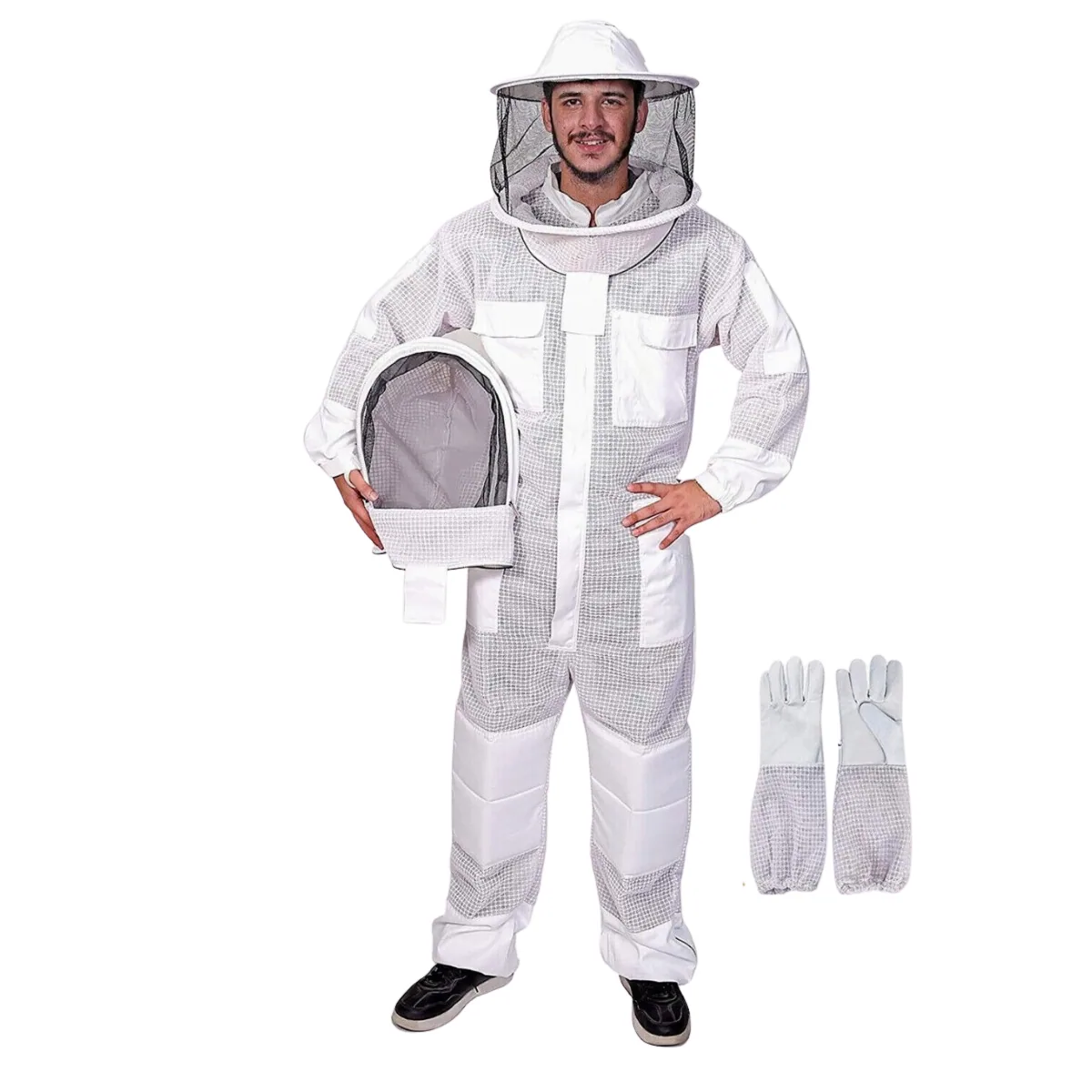
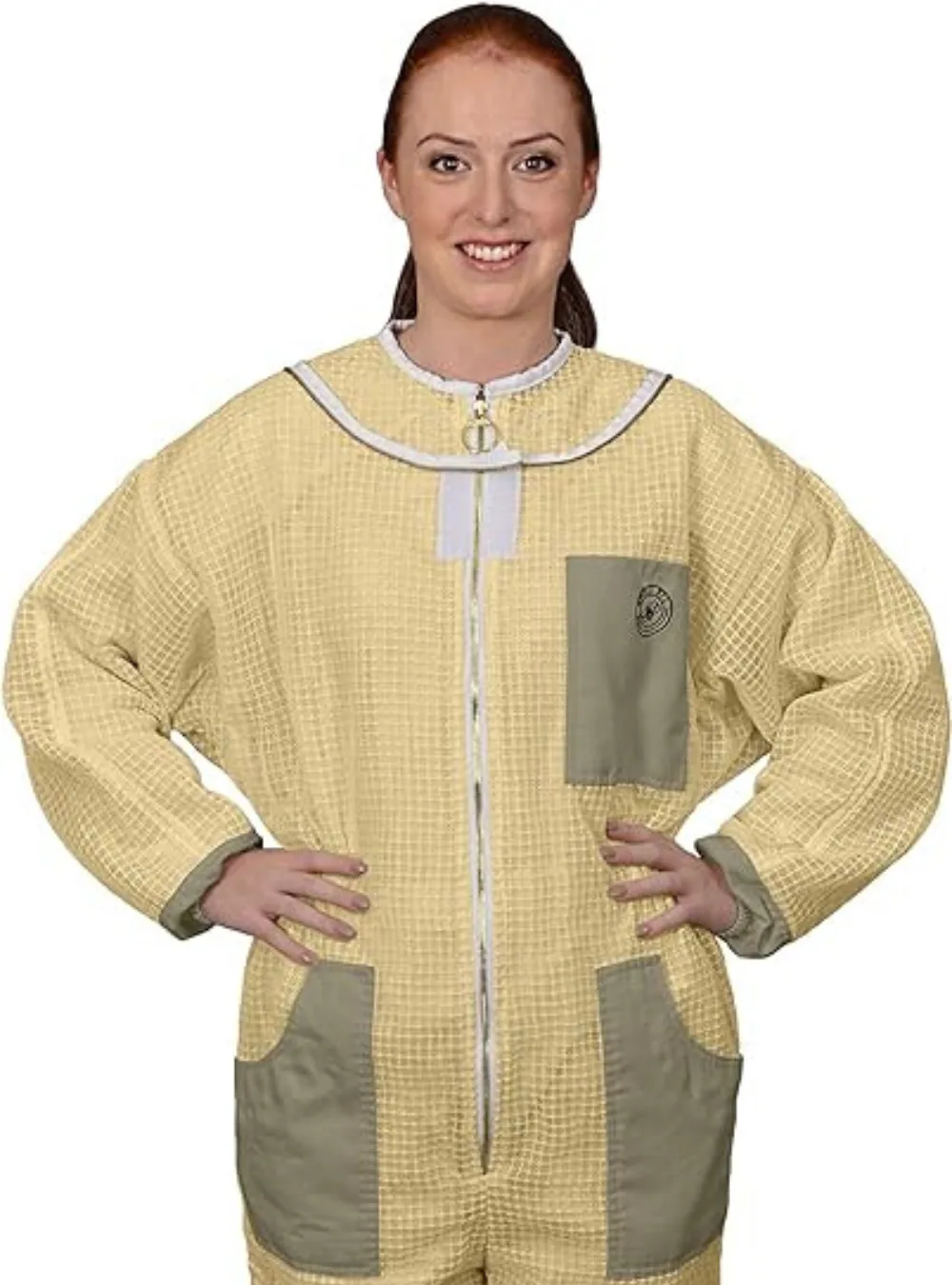
A three-layer suit is built around that fact. Two mesh faces are held apart by a springy middle layer, so the outer surface cannot be pushed against your skin even when you lean on it. The gap travels with the garment instead of disappearing when the fabric is pulled.
That is a mechanical answer to a mechanical problem, and it is why ventilated suits are harder to sting through than cotton ones despite being full of holes. Three-layer versus two-layer mesh covers how much the middle layer varies.
Cotton achieves the same thing by being loose. It works, and it depends entirely on the suit still being loose at the moment it matters — which is why fit matters more on a cotton suit than on a ventilated one.
Does thicker fabric stop a sting through a bee suit?
Less than people assume, and it costs you something real.
Weight and thread count stop a sting that was going to fail anyway. Neither does anything about compression, which is the actual failure mode. Pull a heavy cotton suit tight across a shoulder and it protects you exactly as well as a light one pulled tight across the same shoulder — which is to say, barely.
What a heavy suit does reliably is make you hotter, and a suit you are too hot to keep closed is the least protective suit there is. Ventilated versus cotton is the decision; weight is not the axis it turns on.
What about wasps and hornets?
Different animals, and the difference matters. A wasp's sting is smooth rather than barbed, so it can sting repeatedly, and a hornet's is longer than a honey bee's.
The mechanism a bee suit uses still works - a gap is a gap, and a longer sting simply needs a slightly larger one. But the margin is narrower, and a suit that is adequate for honey bees under pressure is closer to its limit with hornets. If you are dealing with wasp or hornet nests rather than bees, that is a different trade with different equipment, and it is worth taking advice locally rather than assuming a bee suit covers it.
Is any bee suit completely sting proof?
No, and a supplier claiming otherwise is telling you something about the supplier. Any garment can be pressed against skin by a strap, a kneeling position or a wall, and at that point the gap is gone.
Nobody publishes a meaningful number for it either. No standard test exists for "stings resisted", the way one does for cut resistance in other trades. So anyone quoting you a figure chose it rather than measured it. What we can say honestly is which construction keeps its gap under pressure. That is what this page is about.
What reduces a sting through a bee suit, in order
| What you change | Effect |
|---|---|
| Ventilated rather than single-layer construction | Large. The gap survives compression. |
| A suit that is slightly loose rather than snug | Large, and free. |
| A thin layer underneath | Moderate. Adds millimetres exactly where the fabric touches. |
| Cuffs and ankles that still grip | Moderate, and the one most often neglected. |
| Working calmly and slowly | Moderate. Fewer stings attempted in the first place. |
| Heavier fabric, or a higher GSM | Small, and it makes you hotter. |
Two of the top four are free. What to wear underneath covers the third, and it is the cheapest real improvement most beekeepers can make.
Stung through the suit: what it is telling you
A sting that gets through is information rather than bad luck. Work out which of the five places it came from.
Stung at a cuff? That points straight at the elastic. Check it: slack cuffs fail first on any suit, and they fail invisibly. One on a shoulder or a thigh means the suit is too small, or that you need a layer under it. At the face, the veil is touching you, and a cap under it usually fixes that.
Happening in several places on an older suit? Press the fabric between finger and thumb. Mesh that squashes flat and stays there has lost its gap. Nothing restores it.
Where this matters most
A sting through a bee suit is rare in an ordinary inspection, because an ordinary inspection barely tests one. A defensive colony in a wall does, for an hour, from every angle, while you are pressed against a joist. Removal work is the case where the gap is under constant attack and single-layer garments stop being an option.
For regional guidance on colony temperament and on working safely with defensive bees, Penn State Extension's beekeeping resources and the University of Georgia Bee Program are better sources than anyone selling suits, including us.
Does a sting through a bee suit mean it has failed?
Not necessarily, and it is worth being clear about this before you replace something that is working.
A sting at the wrist on a day you were reaching deep into a tall stack is the suit doing what a suit does, in a position that defeats any garment. A sting on your back while standing upright is different: nothing was pulled tight and nothing was open, which means something is wrong with the fabric or there is a hole.
The useful question is whether you can explain it. If you can - sleeve rode up, knelt on it, veil was touching - the suit is fine and the habit needs changing. If you cannot explain it, go and find the hole.
What to do about it
- Buy loose rather than snug, and ventilated if you can — the full kit list is here.
- Wear one thin layer underneath, always.
- Check the cuffs every season by stretching and releasing them.
- Put a thin cap under the veil, or a brimmed hat if yours is a round veil.
- Raise the hive so you are not folded over it, which is what pulls fabric tight.
Our three-layer ventilated suits are built around the gap described here, and how a bee suit should fit covers the other half of it.