
Beekeeping trousers: do you need them?
Most beekeepers never buy a separate pair — a jacket plus your own trousers, or a full coverall, covers it. Here is when the third option is right.

Beekeeping trousers are the part of a kit most people never buy. Most beekeepers do not need separate beekeeping trousers. A jacket over your own long trousers covers ordinary inspections, and a full coverall covers everything else without a join at the waist. Separate trousers are worth it in one specific case: when you need lower-body protection that your own clothes cannot give, and a coverall is too hot or too awkward to put on.
Beekeeping trousers and the two alternatives
| Arrangement | Good for | The catch |
|---|---|---|
| Jacket plus your own trousers | Most inspections. Cheapest, coolest, easiest to launder | Your trousers have to actually do the job — see below |
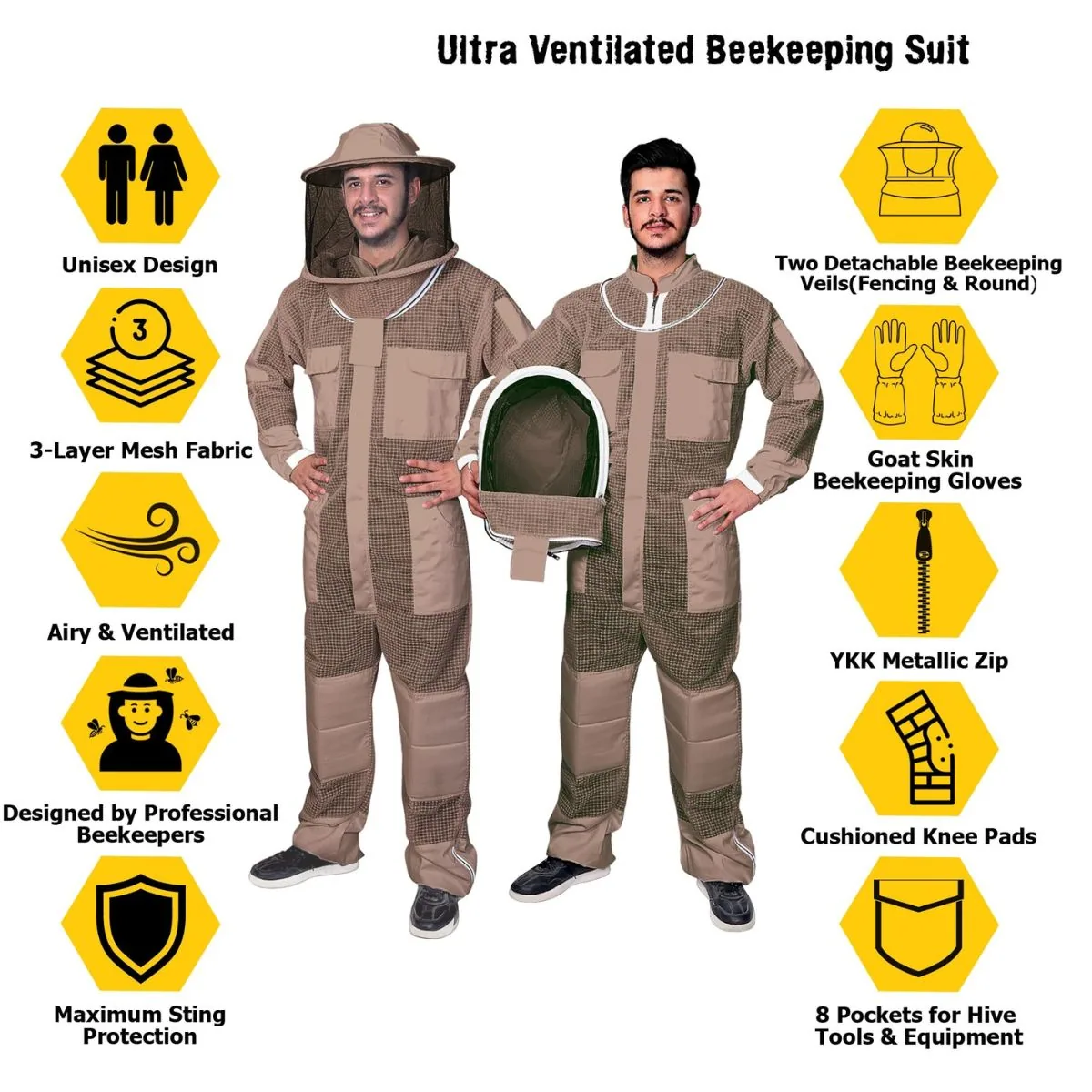
| Full coverall | Kneeling, rough ground, children, removal work | Hotter, slower to get into, one garment to wash |
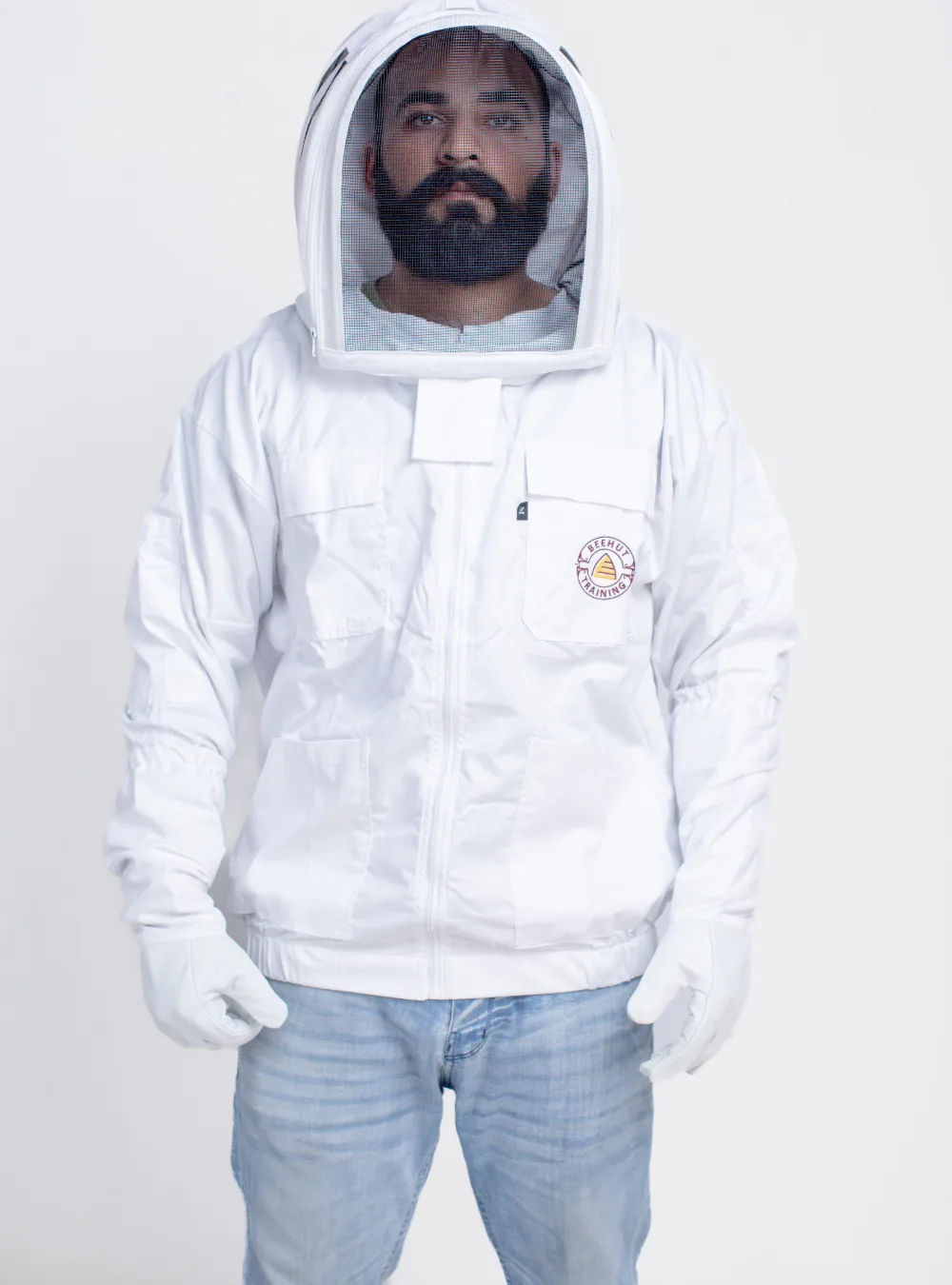
| Jacket plus beekeeping trousers | Long hot sessions where you still need real leg protection | A join at the waist, and two garments to buy |
Bee suit versus bee jacket is the first of those decisions in full. This page is about the third column.
What your own trousers have to do
If you are wearing a jacket, your legs are protected by whatever you happened to put on, so it is worth being deliberate about it.
- Warm enough for the season, because this is the half you layer for early-season inspections.
- Full length, loose, and not stretchy. Leggings and skinny jeans are pulled tight against the skin, and fabric touching you is fabric a sting can cross — that is the whole mechanism.
- Pale. The same convention that applies to the suit applies to the half of you not wearing one.
- Long enough to go over a boot, with the leg outside the boot rather than tucked in.
- Thick enough to matter. Thin summer trousers are better than shorts and not by much.
Loose cotton work trousers are the honest answer, and most people already own a pair.
When separate trousers earn their place
Four cases.
You work long sessions in real heat. A ventilated jacket with ventilated trousers is cooler than a ventilated coverall, because the join at the waist is another place air can move. If you are in the apiary for hours in high summer, that is a genuine difference.
You need to get out of it quickly. Two garments come off faster than one, and the top half can come off on its own between hives.
You launder constantly. A teaching set or a removal business washes the legs far more than the top. Separate pieces mean replacing the half that wears out.
A coverall does not fit you. Legs are the dimension that varies most between bodies, and a coverall has to fit your chest and your inseam at once. Separates let you size each half — the same problem a tall frame runs into.
What ventilated trousers would have to do
Worth setting out, because it is the standard to judge any pair against.
- Hold a gap at the knee. Kneeling is the position where legs are pressed hardest against fabric, so the construction has to survive compression exactly there.
- An elasticated ankle, not a drawstring. Nothing to set wrong, and nothing to come undone when you crouch.
- A high enough waist to overlap the jacket through a full bend forward.
- Enough rise to kneel in. The measurement most often got wrong on separates, because it is scaled from the waist rather than measured.
A pair that fails the first or the last is a pair of work trousers with a label on them.
Sizing beekeeping trousers separately
The advantage of two pieces is that you can size each half, and the advantage is wasted if you order both by the same number.
Measure your waist and your inseam rather than reading across from a chest size - inseam is the dimension a coverall scales rather than measures, and it is the reason separates fit some people better. Measure the inseam wearing the boots you work in, because that is the length that has to reach.
The catch nobody mentions
Beekeeping trousers and a jacket make a two-piece, and any two-piece has a join at the waist, and a join is the weakest point of any garment. When you bend over an open hive the jacket rides up and the trousers stay put.
So a two-piece needs overlap — a long jacket that comes well below the waistband, or an elasticated waist high enough that the gap never opens. Check it the way you check everything else: put it on, bend forward as if lifting a frame, and have someone look at your back.
A coverall has no such join, which is its main argument.
What we make, and what we do not
We do not currently sell beekeeping trousers on their own. That is worth saying plainly, because people search for them and arrive here: the catalogue runs to full suits, jackets, veils and gloves, and the lower half is covered by a ventilated coverall or by your own trousers under a jacket.
If you specifically need separates, a made-to-measure suit can be cut to your inseam rather than scaled from your chest, which solves the fit reason for wanting them. The heat reason it does not solve, and we would rather tell you that than sell you a coverall for it.
Whatever you wear below the waist
- The leg goes over the boot, never tucked in. Tucked in, the opening points upwards.
- Boots with a high shaft, so the leg has several inches of overlap to lose when you crouch. Elasticated ankles beat drawstrings here.
- Long socks as a backstop.
- Loose rather than snug, everywhere you might kneel.
Sealing wrists and ankles covers the ankle in full — it is the second most common place beekeepers get stung, and almost all of it is footwear rather than the garment.
For a general protective-kit list from somewhere with nothing to sell, Penn State's beekeeping basics and the University of Georgia Bee Program both set out what a kit has to cover.