
Is a custom made bee suit worth it?
A made-to-measure suit is worth it when a standard size fails you in a specific, repeatable way — not simply because it costs more. Here is how to tell which you are.

A custom made bee suit is worth it when a standard size fails you in one specific, repeatable way — sleeves that ride up, a crotch that pulls when you crouch, a hood that sits wrong because your shoulders and your chest are two different sizes. It is not worth it because it costs more, and it is rarely worth it in your first season.
What a size chart actually assumes
A graded size is built from one measurement — usually chest — and every other dimension is scaled from it by a fixed ratio. That ratio is an average of a lot of bodies. It fits most people acceptably and almost nobody exactly.
The places it breaks are predictable. Someone tall and narrow buys for height and gets a suit that billows. Someone broad and short buys for chest and gets sleeves over their knuckles. Neither suit is faulty; both are the chart doing exactly what a chart does.
If you are still working out what beekeepers wear at all, start there rather than here. This is worth being clear about because the usual framing — cheap suits fit badly, expensive suits fit well — is wrong. A well-made graded suit and a badly made one have the same problem at the extremes of the range. What varies is how honestly the range is published.
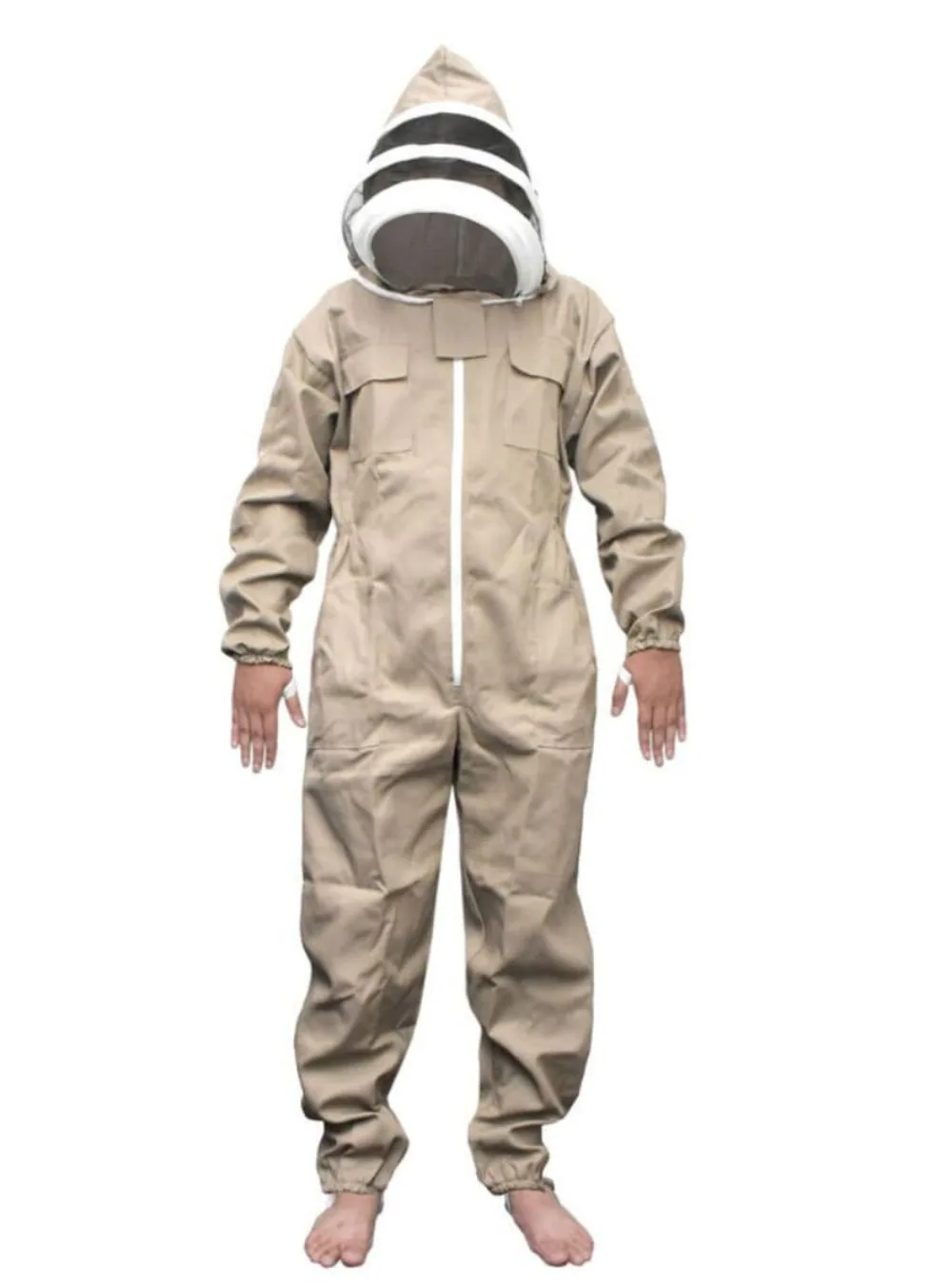
A custom made bee suit is not the same as made to order
Two phrases that get used interchangeably and mean different things.
Made to order means the suit is sewn after you buy it, in a standard size. You wait, and you get a stock garment. The advantage is choice of fabric and colour, not fit.
Made to measure means the pattern is adjusted to measurements you supply. Sleeve, inseam and back length stop being tied to chest and become numbers of their own.
If a listing offers a custom made bee suit without saying which it means, ask which measurements it takes. A supplier that asks only for your chest and height is selling you made to order with a different label.
The three faults that measuring actually fixes
Most fit complaints come down to one of three, and all three are dimensions a chart cannot vary independently — which is exactly what a custom made bee suit does differently.
- Sleeve against torso. Arms and chest do not scale together, and the shoulder seam decides where the sleeve hangs from — the fault women's bee suit sizing runs into first. A suit cut for your chest with sleeves cut for someone else's is the single most common cause of a cuff that creeps above the glove.
- Rise. The distance from waist to crotch decides whether you can kneel at a hive without the whole suit pulling tight across your thighs — and fabric pulled tight against skin is where a sting reaches you.
- Neck and shoulder. The veil's standoff depends on where the collar sits. A collar an inch out of place puts mesh closer to your face than it was drawn to be.
If none of those three describes your experience, a standard suit is doing its job and the money is better spent on a second veil or a decent pair of gloves.
What each measurement of a custom made bee suit controls
| Measurement | What it decides | What goes wrong when it is scaled instead of measured |
|---|---|---|
| Chest | Whether the suit closes, and how much slack you carry | Little. This is the one a chart gets right. |
| Sleeve length | Whether the cuff stays over the glove through a reach | The cuff rides up at exactly the wrong moment |
| Inseam | Whether the ankle stays over the boot through a crouch | Everything below mid-calf is protected by a sock |
| Back length | Where the collar sits, and so where the veil sits | The suit drags down when you bend and the veil follows |
| Hip and seat | Whether you can kneel without the suit pulling | Fabric tight across the thigh, which is contact |
| Height | Nothing on its own — it is a proxy for the two above | Buying by height alone is how people end up in a tent |
When a custom made bee suit is worth it
Four cases, in rough order of how clearly the maths works out.
- You are between sizes and always have been. If you have read which size to pick when you are between two and the answer is still "neither", that is the chart telling you it has run out.
- Your proportions are not the chart's. Very tall, very short, or a chest-to-waist difference that forces you to buy two sizes up to close a zip. Plus-size fitting and suits for tall beekeepers both end up here.
- You wear it daily. A suit that annoys you once a month is a nuisance. A suit that annoys you every day of a season is a suit you stop wearing properly, and a suit worn badly is the one you get stung in.
- You need something a stock suit does not have — including a colour the range does not run — a particular fabric, a colour, a name or a club badge, or the extra reach removal work asks for overhead.
When it is not
In your first season. Not because beginners do not deserve a good suit, but because you do not yet know what to specify. The faults above are things you discover by wearing a suit through a summer; before that you would be guessing, and a guess cut to your measurements is still a guess — it is just an expensive one. Spend the first year in a stock suit at an association apiary instead; Penn State Extension's beekeeping resources are a good place to find what training exists near you.
When the real problem is the size you bought. Read the signs a suit is the wrong size first. A lot of "I need custom" turns out to be "I need the next size down", and a lot of the rest turns out to be a veil shape that does not suit the wearer.
When a jacket would solve it. Legs are the dimension that varies most between bodies. If your fit problem is below the waist, a jacket with your own trousers removes it entirely and costs less than either option.
What a custom made bee suit does not fix
Worth saying plainly, because expectations are where disappointment comes from.
- Heat. Fit does not cool you; the fabric and its construction do. A measured cotton suit is still a cotton suit — see ventilated versus cotton, and what colour actually does in heat.
- Veil clearance at the face. That is decided by the veil's shape, not by your measurements — a fencing veil follows your head whoever cut it.
- Durability. A suit cut to you wears out the same way — how long a bee suit lasts depends on storage and laundry, not on who drafted the pattern.
What you give up
Two things, and they are worth knowing before you order.
Time. A suit cut to your measurements is made after you order it. It does not ship the same day a stock size does, and the wait is real.
The standard return window. A suit cut to one person's measurements cannot be resold, which is why consumer law in the UK and the EU excludes made-to-order goods from the statutory right to cancel. Our returns policy covers it with a fit guarantee instead: if it does not fit, it comes back and gets altered or recut. That is a different promise from "send it back for a refund", and you should take it as the promise it is. What to check in a warranty goes through the questions worth asking any supplier about this.
Deciding on a custom made bee suit in five minutes
Put on the suit you have, with the boots and gloves you actually use. Then crouch as if opening a hive, reach forward as if lifting a frame, and look down at your own boots.
If the cuffs stay over your gloves, the thighs do not pull, and the veil keeps a visible gap from your nose — the suit fits, and a measured one would be a luxury rather than a fix. If any one of those three fails in the same way every time, that is the fault measuring removes, and it will keep failing in every stock size you try.
Two of the three failing at once is the clearest signal there is. One failing is usually cheaper to solve another way: over-sleeves for a short cuff, gaiters for a short ankle, a different veil shape for a crowded face.
If the sums are close, what drives the price of a suit sets out what the money actually buys. The size guide lists the measurements we take, and how to measure for a bee suit walks through taking them properly — the two that people get wrong are sleeve, which should be measured with the arm bent, and inseam, which should be measured in boots. A custom made bee suit is only as good as the numbers it was cut from, so take them twice. The custom-fit suit is cut from them.