
Buying guides10 min read
How to Measure for a Bee Suit: Nine Measurements, Done Right
Measure over the clothes you wear to the hive, with a soft tape and a helper. Here are the nine measurements we cut suits to, the mistakes that make a suit tight, and what to do with the numbers.

Here is how to measure for a bee suit: wear the clothes you put on under the suit, use a soft tailor's tape, and get someone to help. Take nine measurements: chest, waist, hip, height, inseam, sleeve, neck, shoulder, and how loose you like it. Chest and height decide your size. If they disagree, size up.
Key takeaways
- Measure over your beekeeping clothes, not bare skin. The suit goes on over jeans and a shirt, so measure over them.
- Chest and height choose the size. The other seven measurements refine the fit, and all nine are what a made-to-measure suit is cut to.
- Stand naturally. Standing to attention adds to your chest measurement, and the finished suit is then tight when you actually move.
- A bee suit is meant to be loose. The gap between the cloth and your skin is part of the protection.
- Between two sizes, take the larger one. A slightly big suit protects; a slightly small one pulls tight exactly where stings get through.
Why measuring for a bee suit is different
Most clothes are measured to fit close. A bee suit is measured to fit loose, and the reason is the sting itself.
A honey bee's stinger is short. Where the fabric lies flat against your skin, a bee on the outside can push its stinger through the weave. Where there is air between fabric and skin, it cannot reach you. That gap is why our size guide opens with the line "a bee suit is meant to be loose — the gap between cloth and skin is part of the protection."
It is also why a suit that fits perfectly while you stand still can fail you at the hive. You crouch to look at a bottom box, reach across to lift a frame, and kneel to read the entrance. Each of those movements pulls the cloth tight somewhere: across the shoulders, the seat, the knees. Texas A&M AgriLife Extension gives the simplest test there is: "while suited, the person should be able to touch their toes without the suit or jacket pulling tight along their back or pulling the veil against their face." (Texas A&M AgriLife Extension, ENTO-097)
Measuring well is how you pass that test before you have bought anything.
What you need before you start
- A soft tailor's tape. A metal builder's tape cannot follow the body and gives numbers that are too small around the chest and hips.
- A helper. You can take your chest, waist and hip alone in a mirror. Height, inseam, sleeve and shoulder need someone else, because reaching round to measure yourself changes your posture.
- The clothes you wear under your suit. Jeans and a long-sleeved shirt for most people; add a fleece if you inspect in early spring. Our size guide puts it plainly: measure "over the clothes you would normally wear underneath."
- Something to write on. Write every number down as you take it, with the unit. Inches and centimetres get mixed up more often than you would think.
How to measure for a bee suit: the nine measurements
These are the nine measurements we cut our made-to-measure suits to, in the order we take them. The same nine tell you which ready-made size will work.
Chest. Around the fullest part, with the tape level under your arms. Stand naturally and breathe normally. Standing to attention adds to the number and makes the finished suit tight when you move.
Waist. At the navel, not where your trousers sit. On most people that is higher than the belt line.
Hip. Around the fullest point of the seat, with your feet together.
Height. Barefoot, back against a wall, heels touching it. Your helper lays a book flat on your head and marks the wall.
Inseam. Barefoot, from the crotch straight down to the floor. Do not measure a pair of trousers instead: trousers are cut shorter than a suit leg needs to be.
Sleeve. From the centre-back of your neck, over the shoulder, to the wrist bone, with your arm slightly bent. A straight arm gives a sleeve that is short the moment you reach for a frame.
Neck. Around the base of the neck, with one finger under the tape.
Shoulder. Across the back, from the bony point of one shoulder to the other.
Preferred ease. How loose you want the suit. Most beekeepers want a generous amount over the chest measurement, because the gap is part of the protection.
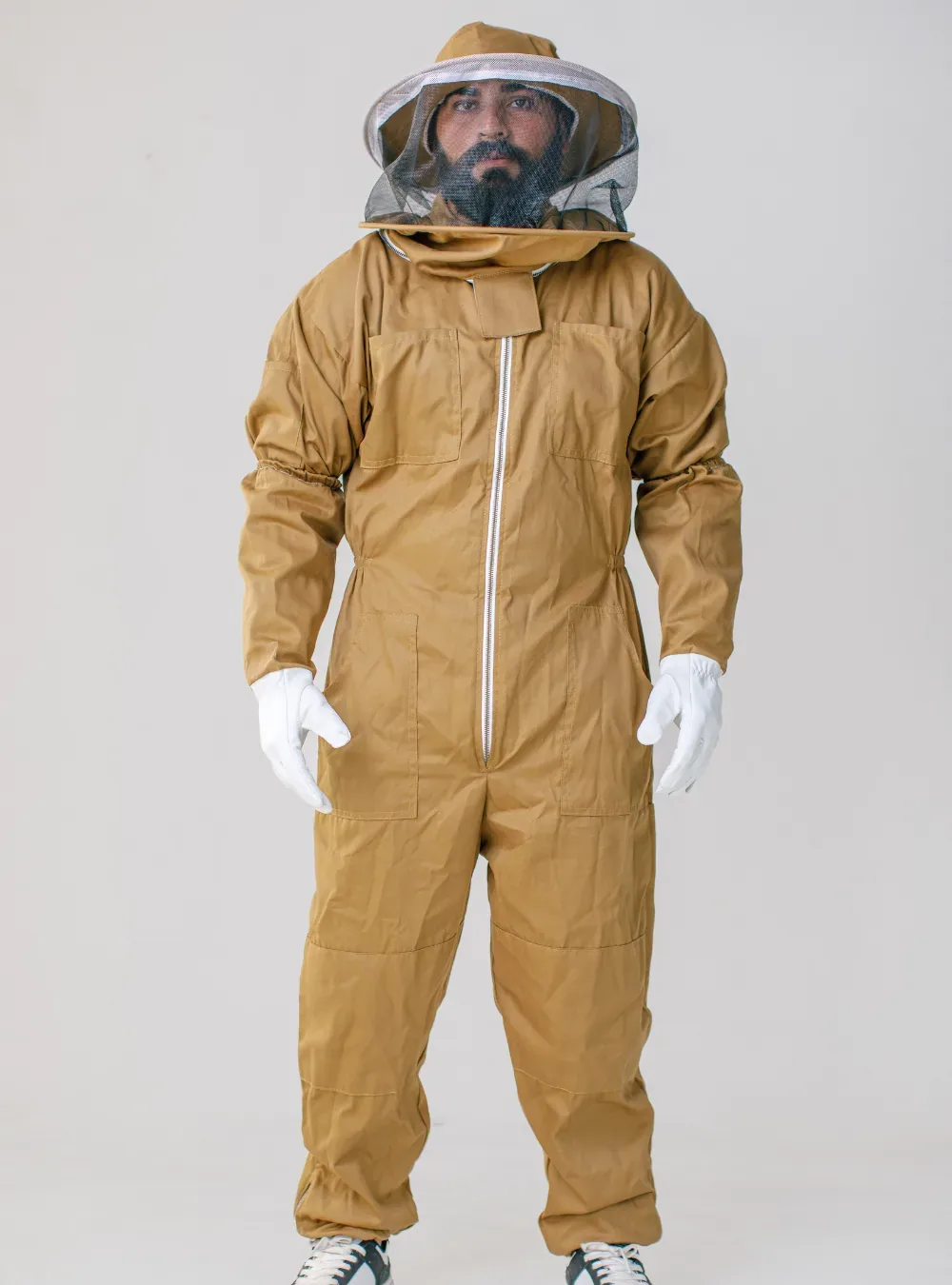
Which measurements decide your size
| Measurement | What it controls | What goes wrong if it is off |
|---|---|---|
| Chest | Whether the suit closes without strain | Fabric pulls tight across the shoulders and upper back |
| Height | Overall body length of the suit | Crotch rides up; legs lift off your boots when you crouch |
| Inseam | Leg length | Ankle gaps when you kneel or climb |
| Sleeve | Arm length | Wrists come out of the gloves when you reach |
| Shoulder | Width across the back | Tight seam when you lift a heavy box |
| Waist and hip | Room through the middle and seat | Seat pulls tight when you squat |
| Neck | Collar and veil attachment | Veil zip strains or gapes at the throat |
| Ease | How much air sits between suit and body | Too little: stings through the fabric. Too much: snags and trips |
For a ready-made suit, the first two rows do most of the work. Chest tells you whether the suit will close comfortably over your clothes. Height tells you whether it is long enough for you to bend. The rest decide how well that size fits you in particular, and they are what a made-to-measure suit uses to fit you exactly.
Taking each measurement properly
Chest: the one people get wrong
Chest is the measurement most likely to be too small, for two reasons. People pull the tape tight, and people stand up straight and puff out slightly when someone is measuring them.
Keep the tape level all the way round. It should sit under your armpits and across the widest part of your back, not ride up at the back. Let it lie flat against your shirt without pressing in. Then breathe out normally and read it.
Height and inseam: measure barefoot, then think about boots
We take height and inseam barefoot so the number is the same every time. Boots add to your height, and a bee suit's legs should go over your boots, not into them. Texas A&M is clear on this: "the suit legs should be worn over shoes or boots — not tucked in."
That is one reason to be generous with the size rather than exact. Allowance for boots, and for the way you crouch at a hive, comes from the cut of the suit and from choosing the larger size when you are unsure.
Sleeve: bend the arm
Measure with your arm slightly bent, the way you hold it when you work. A sleeve measured on a straight arm comes up short when you reach forward to lift a frame, and the gap between glove and cuff is where a bee walks in.
Some suits and jackets have elastic thumb loops to stop the sleeve riding up. The University of Arkansas Cooperative Extension describes them: "Some bee suits and jackets may have an elastic loop sewn into the wrist. Place your thumb through this loop to keep your sleeves in place when you pull on your gloves." (Beekeeping Basics, University of Arkansas) They help, but they do not make up for a sleeve that is too short.
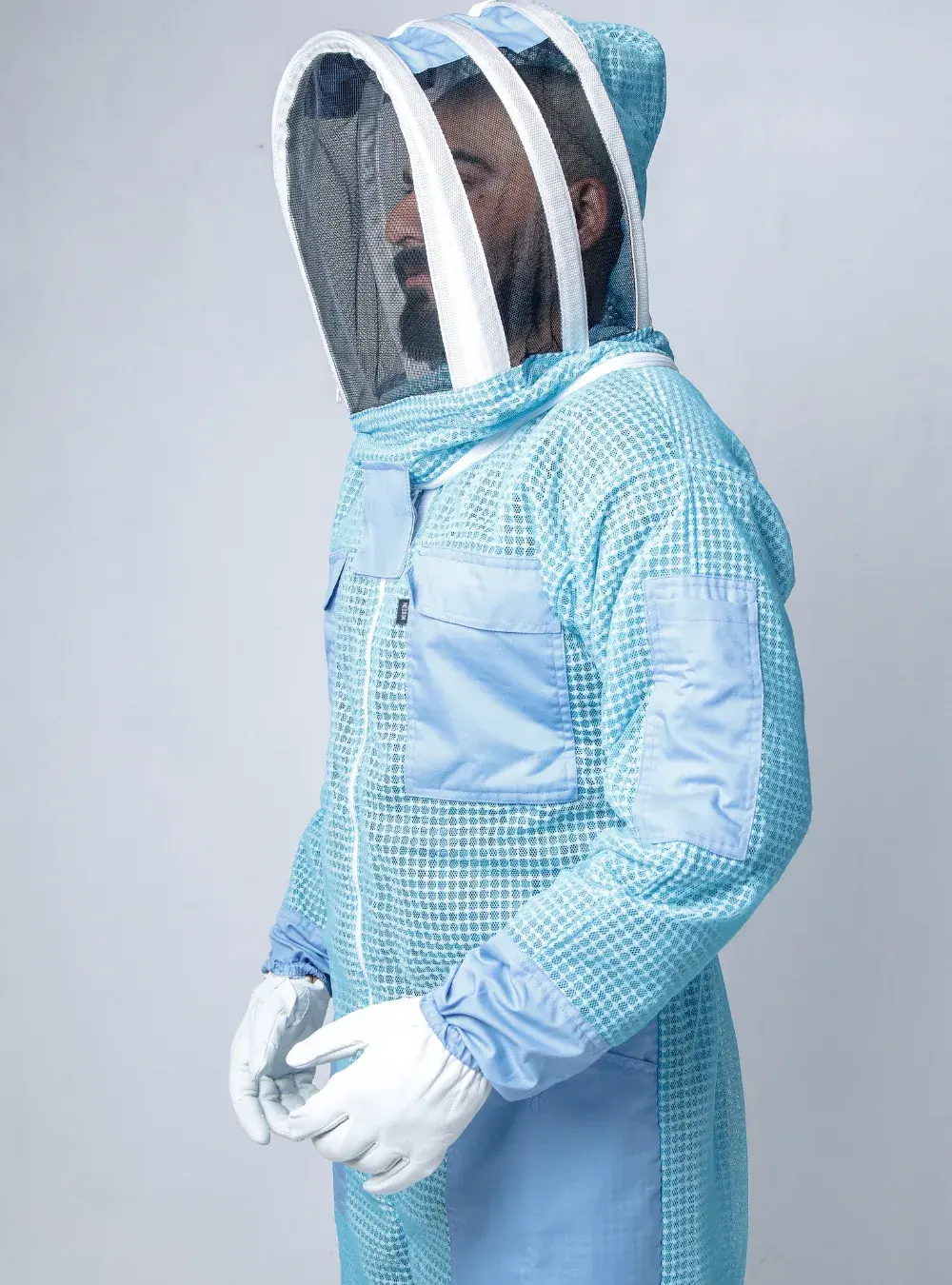
Shoulder: across the back, bone to bone
Find the bony point at the top of each shoulder, where the arm meets the body, and measure straight across the back between them. This is the measurement that decides whether you can lift a full honey super without the back seam pulling tight.
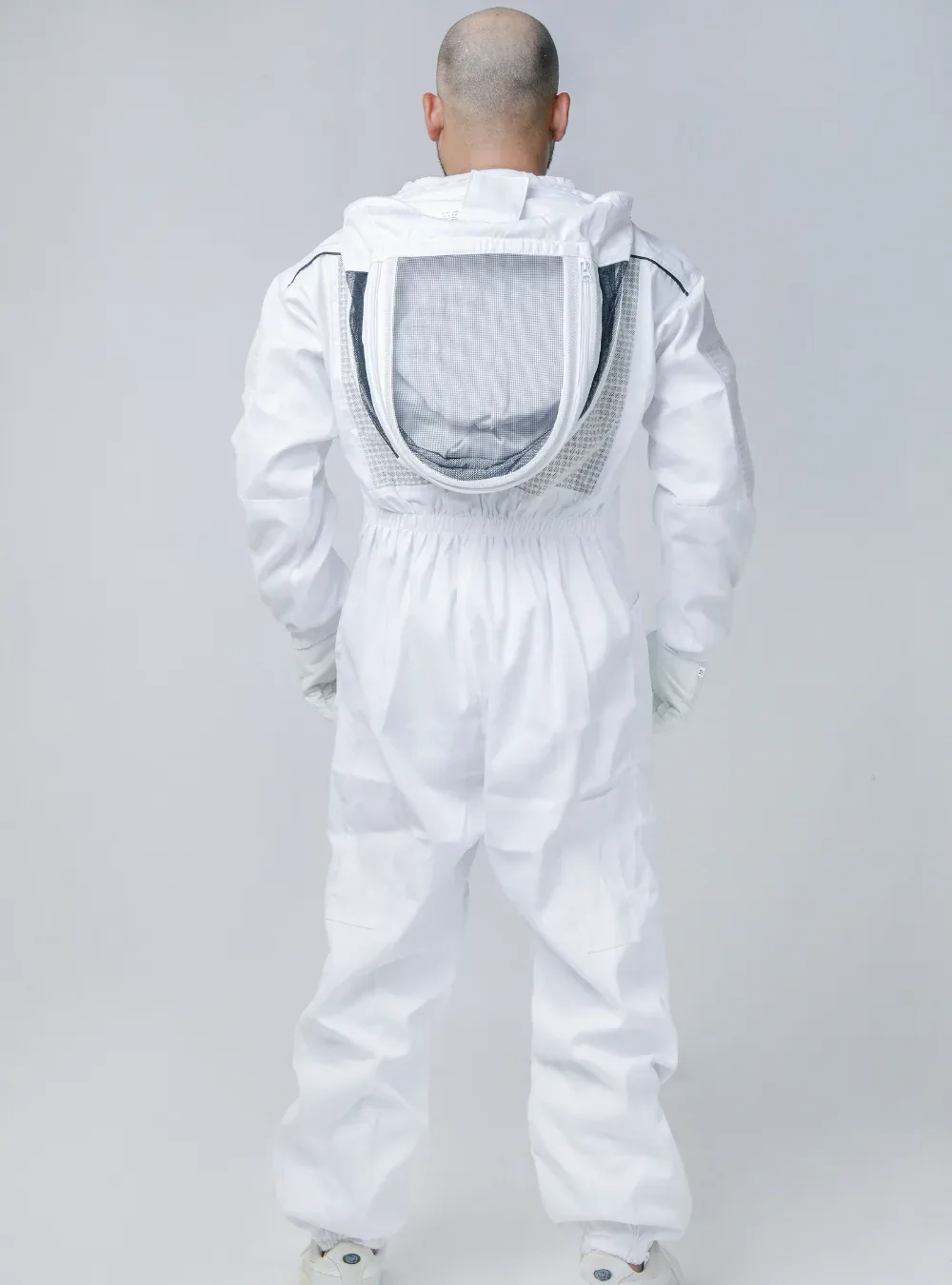
Neck: one finger of room
Measure around the base of the neck with one finger slipped under the tape. The neck measurement matters most on a suit with a zip-on veil, because the veil attaches at the collar. Too tight and the zip strains; too loose and the collar gapes.
Ease: how loose is loose enough
Ease is the difference between your body and the suit, and it is the measurement most guides skip. You do not take it with a tape. You decide it.
Most beekeepers want a generous amount of ease, especially across the chest and back. If you work in hot weather and wear a ventilated mesh suit, the mesh's own thickness holds the outer layer a little away from your skin. That helps, but it does not replace a loose fit. If you wear a thick layer underneath in spring, you need more.
Common mistakes when measuring for a bee suit
- Measuring bare skin. The suit goes over clothes, so measure over clothes.
- Pulling the tape tight. The tape should lie flat, not dig in.
- Standing to attention. It adds to the chest and shortens the back. Stand as you would at a hive.
- Measuring an old pair of trousers for the inseam. Trousers are cut shorter than a suit leg.
- Measuring with a straight arm. You never work with a straight arm.
- Mixing units. Write inches or centimetres next to every number.
- Choosing the size you wear in shirts. Shirt sizes and bee suit sizes are not the same thing. Use the measurements.
Turning your measurements into a size
We make ready-to-ship suits from X-Small to 5X-Large, plus made-to-measure. On our size guide you will find the full list of sizes and the same measuring steps as above.
We are honest there about one thing: the body-measurement chart for each ready-made size is not published yet. We have the size names, but the chest and height ranges come from the workshop's grading sheet, and guessing them would send people the wrong size. So until that chart is up, here is how to use your numbers:
- Between two sizes, size up. Our size guide says it directly: "A suit that is slightly too big still protects you; one that is slightly too small pulls tight across the shoulders — which is exactly where stings get through."
- If your chest and height point in different directions (a broad chest and short legs, or tall and slim), a ready-made size will compromise somewhere. That is exactly what made-to-measure is for.
- If you are outside the usual range, very tall, very broad, or both, skip sizing altogether.
Our custom-fit bee suit is cut to the nine measurements above. You choose a cotton suit, a ventilated suit, a jacket or a children's suit, and a fencing, round or convertible veil.
Measuring for a bee jacket instead of a suit
For a bee jacket you need the upper-body measurements: chest, waist, sleeve, shoulder and neck. Height matters less, but body length still matters.
A jacket that is too short rides up when you bend over a hive and opens a gap at the waist. When you measure for a jacket, have your helper check how far below your waist the jacket's hem will sit while you bend forward, not just while you stand.
Measuring someone else
Buying a suit as a gift, or for a family member who is starting with you? The same nine measurements apply. Two tips:
- Measure them in the clothes they will actually wear, not what they have on that day.
- If you cannot measure them at all, a jacket is more forgiving than a full suit, and a larger size is more forgiving than a smaller one.
For children, fit is even more important, because a child's suit has to keep fitting through a growth spurt. Measure, then size up.
Check the fit when the suit arrives
Measuring gets you the right size. Trying the suit on properly tells you whether it is right for you. Before you take the labels off, put it on over your beekeeping clothes and your boots, zip the veil, and do four things:
- Touch your toes. The back should not pull tight and the veil should not press on your face.
- Crouch as if looking at a bottom box. The legs should stay over your boots.
- Reach both arms forward. The sleeves should stay inside your gloves.
- Kneel on one knee. The seat and knees should not strain.
Our guide to how a bee suit should fit covers each of these checks in detail. If the suit fails one of them, our guide to the signs a bee suit is too big or too small helps you work out which way to go.
Get a suit that fits
Measure once, then choose: a ready-to-ship suit from X-Small to 5X-Large, or a suit cut to your nine measurements, with your choice of fabric, colour and veil.
Common questions
Should I measure for a bee suit over my clothes?
Yes. Measure over the clothes you normally wear under the suit, such as jeans and a long-sleeved shirt or a fleece in spring. A bee suit goes on over clothes, so measuring bare skin gives numbers that are too small.
What is the most important measurement for a bee suit?
Chest and height together. Chest decides whether the suit closes without pulling across your shoulders, and height decides whether the legs and torso are long enough for you to bend and crouch. If those two point to different sizes, take the larger.
How do I measure my inseam for a bee suit?
Stand barefoot with your feet slightly apart and measure from the crotch straight down to the floor. A helper makes this far more accurate. Do not measure an existing pair of trousers, because trousers are cut shorter than a suit leg needs to be.
How much bigger than my chest should a bee suit be?
Generously bigger. The gap between the cloth and your body is part of the protection, because a sting cannot reach skin the fabric is not touching. We do not publish a single ease figure, because it depends on the suit, but if in doubt, size up.
Can I measure myself without help?
You can measure chest, waist and hip alone in front of a mirror. Height, inseam, sleeve and shoulder are much more accurate with a helper, because reaching round to measure your own back or arm changes your posture and the number.
What if my measurements fall between two sizes?
Choose the larger size. A suit that is slightly big still protects you; a suit that is slightly small pulls tight across the shoulders, knees and seat, which is where stings get through. If you are far apart between sizes, a made-to-measure suit avoids the problem.
Do I measure the same way for a bee jacket?
Mostly. For a jacket you need chest, waist, sleeve, shoulder and neck. Height matters less, but torso length still matters, because a short jacket rides up when you bend over a hive.
Written by Alex, Bee suit maker, BEESUITWEAR · United States.
Writes about protective clothing from the workshop where the suits are made.