
Ventilated vs Cotton Bee Suit: Which One Is Right for You?
Cotton stops a sting by being thick; ventilated mesh stops it by holding the fabric further away than a sting can reach. Which you need comes down to how many hours you spend at an open hive in the heat.

The ventilated vs cotton bee suit decision comes down to heat. Buy a ventilated suit if you keep bees anywhere that gets properly hot, if your inspections run longer than twenty minutes, or if heat is the reason you cut visits short. Buy a cotton suit if your season is mild, your budget is tight, or you want one garment that will outlast several mesh ones. The ventilated suit is cooler and protects through a different mechanism; the cotton suit is cheaper, tougher and quieter, and it will cook you in August.
Key Takeaways
- They protect in two different ways. Cotton stops a sting by being thick. Mesh stops it by holding the outer surface further from your skin than a sting is long.
- A ventilated suit is dramatically cooler, and that is the whole reason it exists. Everything else about it is a trade.
- Cotton lasts longer. Mesh has a spacer layer that eventually crushes, and once it does the suit looks fine and protects badly.
- Price is not the deciding factor. Our cotton suits run $70 to $160 and our ventilated suits $100 to $160 - the ranges overlap.
- The real question is how many hours a year you will spend standing at an open hive in the heat. Answer that and the suit chooses itself.
The short answer
Most guides frame this as cool versus cheap. That is not wrong, but it hides the more useful point: the two suits are protecting you by different physics, and knowing which one is doing what tells you how to wear each of them.
A cotton suit is a barrier. The weave is dense and the fabric heavy enough that a sting embeds in the fibers before it reaches skin. Its weakness is compression - press cotton flat against your shoulder and its thickness stops being thickness.
A ventilated suit barely relies on thickness at all. Three layers of mesh, with a springy spacer layer between the outer and inner, hold the outside surface a fixed distance from your body. A honey bee's sting is a fixed length. If the gap is bigger than the sting, the sting cannot reach you, and it makes no difference that you can see daylight through the fabric.
That is why a mesh suit you can nearly read a newspaper through is not a compromise on safety. It is a different answer to the same problem.
What a cotton bee suit is
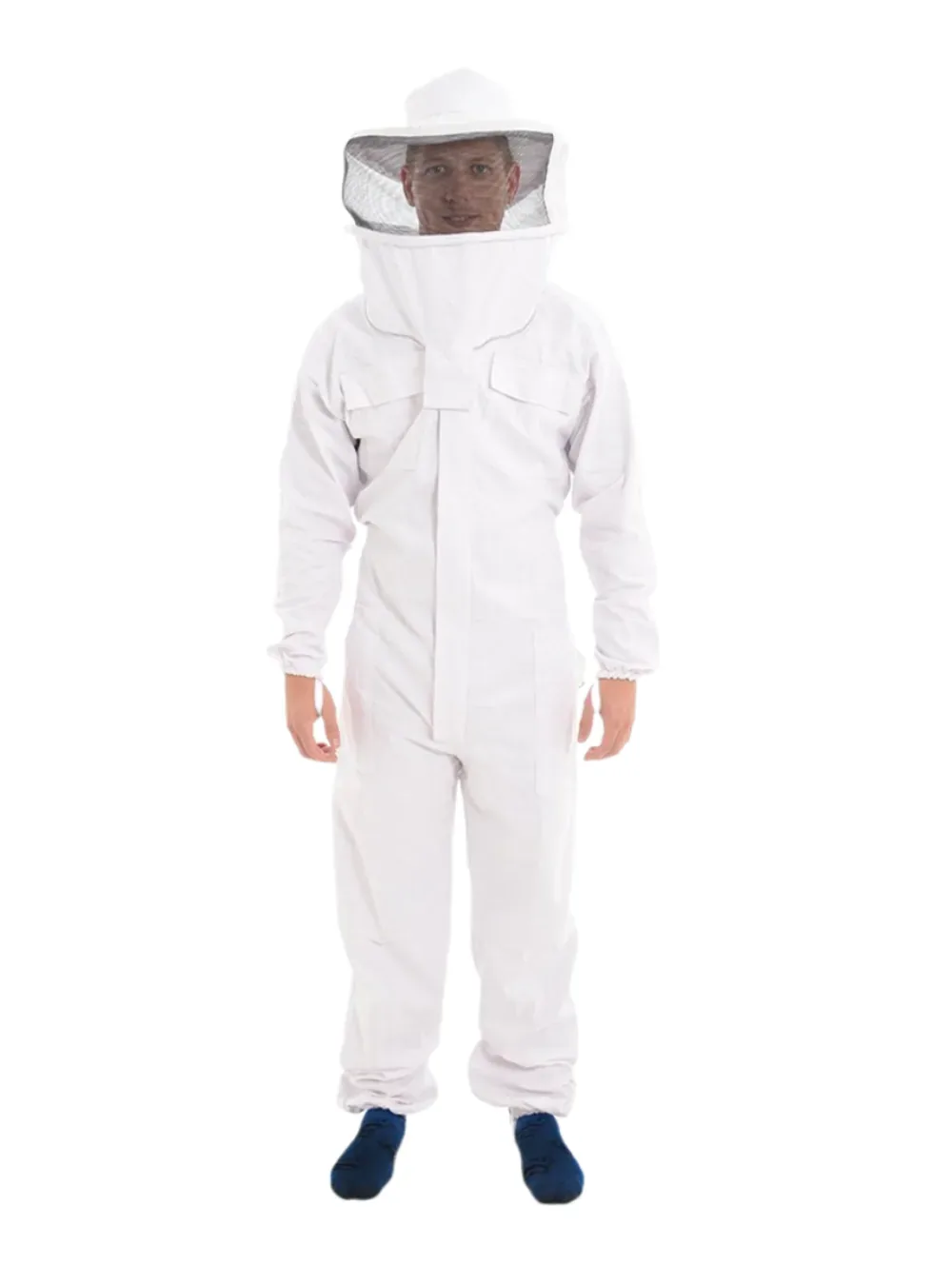
Cotton suits are what most people picture: heavy pale fabric, a fencing or round veil, elastic cuffs. Most are not pure cotton. The common choice is polycotton - a cotton-polyester blend, commonly around 65/35 in either direction - because the polyester adds tear strength and stops the suit looking like a dishcloth after twenty washes.
Fabric weight is measured in GSM, grams per square meter. Beekeeping cotton generally sits between 230 and 280 GSM. Below that you are buying a shirt with a veil attached. The weight is the protection, so it is the number worth asking about.
What cotton does well
It is tough. Cotton drill takes brambles, hive tools and years of washing. There is no spacer layer to crush and no mesh to abrade.
It is quiet. Mesh rustles. Cotton does not. Whether that matters to your bees is arguable, but it matters to some beekeepers working close.
It handles cold. In March, with a wind across the apiary, a cotton suit is the one you want. A mesh suit in early spring is a sieve.
It costs less at the entry point. Our cotton bee suits start at $70.
Where cotton fails
Heat, and nothing else, really. In direct summer sun a cotton suit over your clothes becomes an oven, and the failure is not just discomfort. An overheated beekeeper rushes, and a rushed inspection is a worse inspection. Frames go back crooked, the queen is missed, and the colony gets more disturbed than it needed to be.
The second failure is the compression one. Kneel and the fabric flattens across your knees; lean over a brood box and it flattens across your back. Those are the places suited beekeepers get stung, and it is a fit problem as much as a fabric one. A loose cotton suit is a good suit. A tight one is a thick shirt.
Tip: If you are buying cotton, buy it a size up and check the GSM. Those two things matter more than the brand on the label.
What a ventilated bee suit is
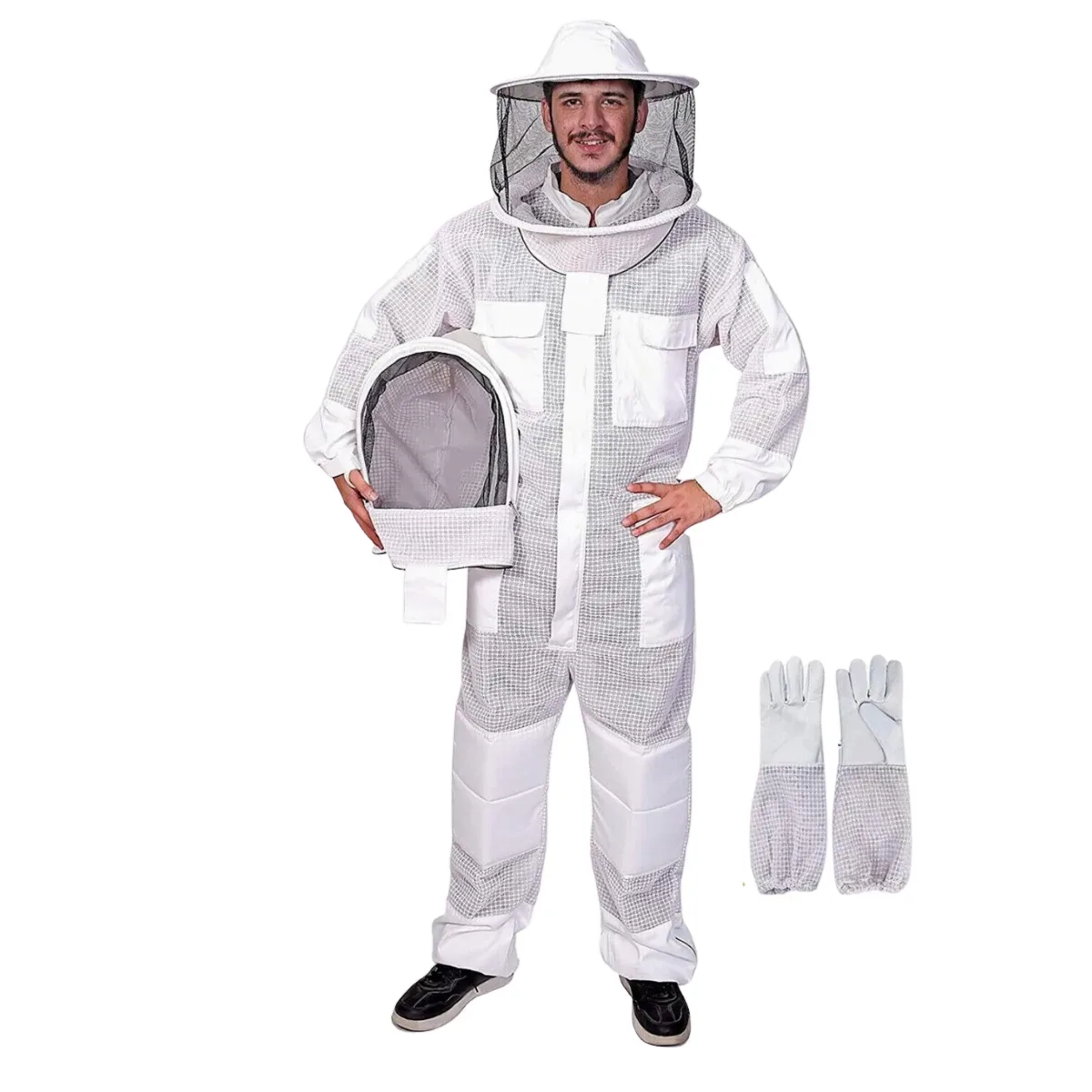
A ventilated suit is built from three bonded layers. An outer mesh a bee can land on, an inner mesh against your clothes, and between them a thick, open, springy layer that holds the two apart.
Air moves straight through all three. So does your body heat, and so does sweat. On a hot afternoon the difference against cotton is not subtle - it is the difference between finishing an inspection properly and finishing it quickly.
What the middle layer actually does
This is the part worth understanding, because it explains everything else about the suit, including how to wash it.
The spacer layer is not there for insulation and it is not there for strength. It exists to hold a gap. That gap is the protection. If you press a ventilated suit between finger and thumb and it flattens easily with no spring back, the gap is not being held, and the suit is not doing its job.
It also explains the one rule that matters most with a mesh suit: never tumble dry it. Heat softens the spacer, the spacer collapses, and you are left with a suit that looks perfectly good and protects like a t-shirt. The damage is invisible and permanent.
Where ventilated suits fall short
They cost more at the top end. Our ventilated three-layer suits run $100 to $160.
They wear out sooner. Mesh abrades. Brambles catch it, the shoulder seam takes the strap of a full super, and the spacer slowly loses its spring. A cotton suit worn the same amount will usually still be in service after the mesh one has been replaced.
They are cold in early spring. The thing that makes them excellent in July makes them useless in March.
They are bulky to pack. Mesh does not fold flat. If your suit lives in a truck box, this is a real consideration.
Ventilated vs cotton bee suit: side by side
| Ventilated (3-layer mesh) | Cotton / polycotton | |
|---|---|---|
| How it stops a sting | Holds a standoff gap wider than a sting | Dense weave the sting cannot pass |
| Heat in summer | Much cooler - air passes straight through | Hot; the limiting factor on long inspections |
| Cold weather | Poor - wind goes straight through | Good |
| Durability | Mesh abrades; spacer eventually crushes | Longer service life |
| Washing | Cool wash, never tumble dry | Cool wash, more forgiving |
| Sound | Rustles | Quiet |
| Packing | Bulky, will not fold flat | Folds small |
| Weak point | Spacer layer collapsing invisibly | Fabric pressed flat against skin |
| Our price range | $100 - $160 | $70 - $160 |
Notice the overlap in that last row. A mid-range cotton suit and an entry-level ventilated suit cost roughly the same, so for most buyers this is not really a budget decision. It is a climate decision.
Which one should you buy?
Buy ventilated if
- Your summers are genuinely hot. Most of the United States, most of Australia, and more of the UK than used to be true.
- Your inspections run long. Anything past twenty minutes at an open hive and heat starts making the decisions for you.
- You have cut a visit short because of heat. If that has happened once it will happen again, and the suit is the fixable part.
- You run more than a couple of hives. More colonies means more time suited up.
- You do removals or swarm collection. Unpredictable work, often in the sun, often for a long time.
Buy cotton if
- Your season is mild or your inspections are in the early morning.
- You keep a hive or two and you are out for twenty minutes at a time.
- You want one suit to last. Cotton is the more durable of the two by a clear margin.
- You work in brambles or scrub. Mesh and thorns are a poor combination.
- You are buying for a child. Children's suits get outgrown before they wear out, and cotton handles being hauled around better - see our children's bee suits.
- Budget is the binding constraint. $70 buys a real cotton suit. It does not buy a real ventilated one.
By climate and hive count
The two questions above collapse into one number: how many hours a year you will spend standing at an open hive in the heat. This is the same table read from the other direction.
| Your situation | Buy |
|---|---|
| Hot summers, 1-2 hives, short visits | Either - cotton is fine if you inspect early morning |
| Hot summers, 3+ hives | Ventilated |
| Hot summers, removals or swarm work | Ventilated, no real alternative |
| Mild summers, any number of hives | Cotton |
| Real four seasons, one suit only | Semi-vented, or cotton plus a jacket for summer |
| Cold-climate spring work | Cotton |
| Working in brambles or rough scrub | Cotton - mesh and thorns do not mix |
| Buying for a child | Cotton - outgrown long before it wears out |
| Tight budget, first suit | Cotton at $70 |
Not sure which way to go? If you are in a hot climate and buying one suit, buy ventilated - heat is the thing that stops people keeping bees properly. Browse ventilated bee suits or cotton bee suits to compare.
How to judge quality in either fabric
Fabric type tells you what the suit is for. It does not tell you whether it is any good. Two suits of the same type can differ more from each other than cotton differs from mesh, and the checks are different for each.
Checking a cotton suit
Ask for the GSM. A seller who knows their product will tell you; one who does not is a warning in itself. Below about 230 GSM you are into shirt territory. Between 230 and 280 is the normal range for a suit meant to be worn at a hive.
Hold it to the light. A dense weave shows an even, tight grain. Thin patches and a visibly open weave are where a sting gets through, and they usually appear first at the shoulders and knees.
Check the elastic. Cuffs and ankles do more to keep bees out than the fabric does. Elastic that has no real tension when new will have none at all after a season.
Checking a ventilated suit
Squeeze it. Take the fabric between finger and thumb and press. It should resist, and it should spring back. That resistance is the spacer layer, and the spacer layer is the protection. A mesh that flattens to nothing under light pressure is a mesh a sting will reach through.
Look at the layer count. Two-layer mesh exists and is cheaper. It is also thinner, which means a smaller gap. Three layers is the standard for a reason.
Check the seams and the shoulder. Mesh abrades where a super rests. Reinforcement across the shoulders is the difference between three seasons and one.
For both
Look at the zips. Two-way zips, a storm flap over the front, and a veil zip that runs smoothly. The veil zip is opened more than any other part of the suit and it is what usually fails first.
Try the four positions. Squat fully, reach both arms overhead, lean forward at the waist, and kneel. Any position that pulls the fabric tight against you is a position you will be stung in, whichever fabric you bought.
What about semi-vented suits?
There is a third option that gets missed in most comparisons: a suit with cotton across the body and mesh panels where heat actually builds - the back, the underarms, sometimes the sides.
This is a genuine middle ground rather than a marketing one. You keep most of cotton's durability and most of its warmth in spring, and you lose the worst of its heat in summer. Our semi-vented suits sit in this category.
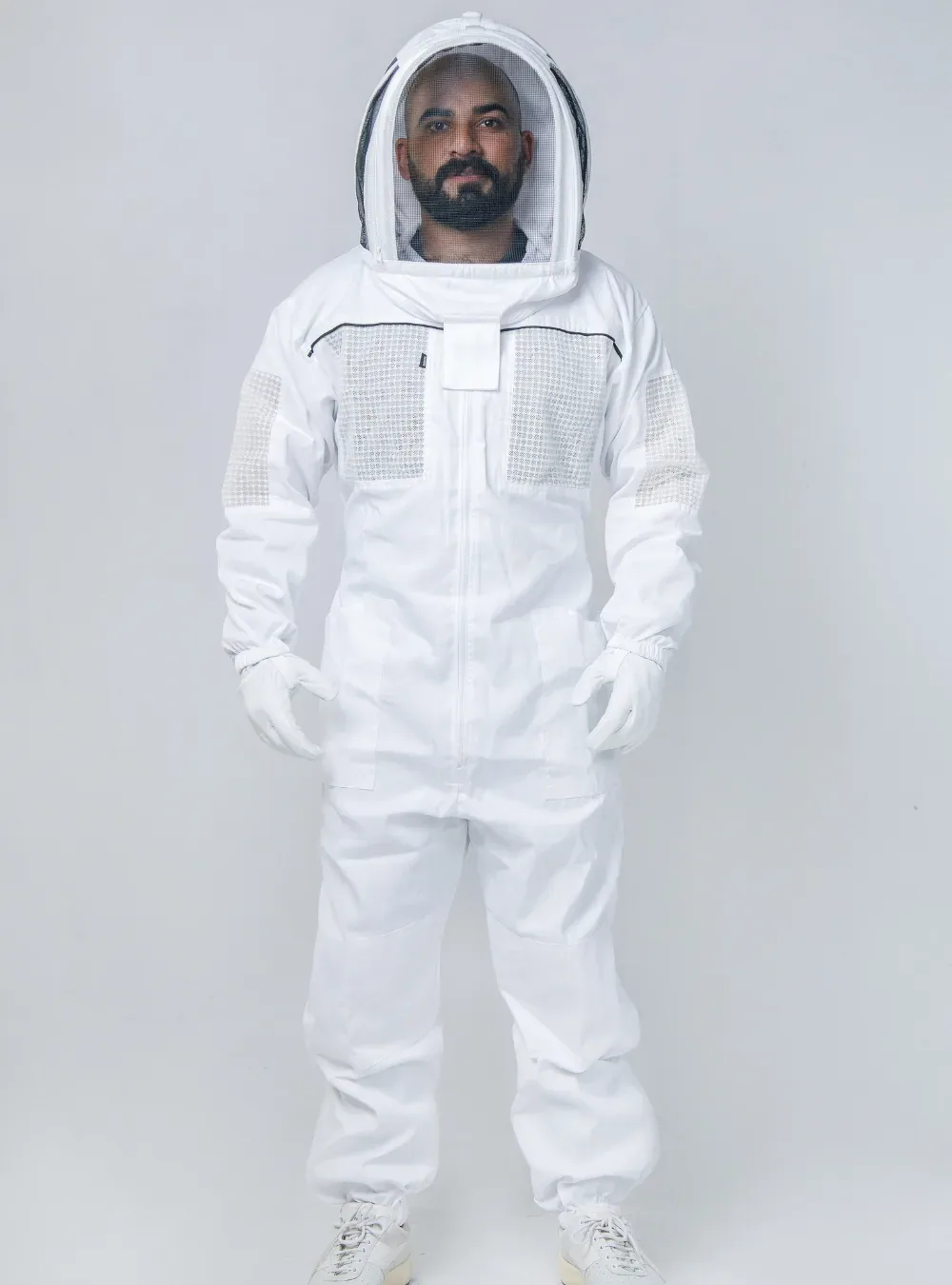
Who it suits: beekeepers with a real four-season year, who want one suit rather than two, and who are not working in extreme heat. Who it does not suit: anyone whose summers are brutal. In genuine heat, a semi-vented suit is a cotton suit with good intentions.
What about the veil?
The veil is a separate decision from the fabric, and it is worth making deliberately rather than taking whatever the suit comes with.
Most ventilated suits ship with a fencing veil, which collapses flat and gives good all-round visibility. Many cotton suits ship with a round veil on a hat brim, which gives better airflow and much better downward visibility - useful, since looking down at frames is what you spend the inspection doing.
The Mid-Atlantic Apiculture Research and Extension Consortium makes the point that the criterion that actually matters is standoff: the veil must hold itself away from your face. Mesh touching skin is mesh a bee can sting through. If you wear glasses, check that clearance specifically before buying. Our veils and hats are sold separately if you want to pair a suit with a different style.
The mistake both camps make
Whichever fabric you choose, the same thing will get you stung: fit.
A sting has a fixed length. Any fabric held away from your skin protects you; any fabric pressed against it does not. This is true of 280 GSM cotton and it is true of three-layer mesh. It is why every serious guide, including the Texas A&M AgriLife Extension protective clothing guide, tells you to buy loose.
So before you agonize over fabric, get the size right. Our size guide lists the measurements we work from, and the rule is simple: measure over the clothes you actually wear at the hive, and if you fall between two sizes take the larger one.
The second shared mistake is the openings. Ankles, wrists, the front zip and the veil-to-collar joint account for most stings to a suited beekeeper - far more than the fabric does. Neither cotton nor mesh helps you if a bee walks in at the cuff. A glove with a proper gauntlet that overlaps the sleeve is worth more than an upgrade in fabric.
Caring for each one
The care differs, and getting it wrong costs you the suit.
Both fabrics: cool water, no fabric softener, no bleach. Softener coats the fibers, holds odour, and on mesh it reduces the airflow you paid for. Treat propolis cold and with patience - scrubbing thins the weave, and a thin patch is a sting waiting to happen.
Cotton specifically: it will shrink if you wash it warm, and shrinkage costs you the looseness the suit depends on. Line dry.
Mesh specifically: never tumble dry, and never vacuum-pack it for storage. Both crush the spacer layer, and that layer is the protection. Hang it in the shade and store it hanging.
Both: zip the veil closed before washing. An open veil zip catches on mesh and tears it, and a torn veil is the end of the garment rather than a repair.
Making the choice
If you are buying one suit and your summers are hot, buy ventilated. Heat is the thing that stops people inspecting properly, and no other feature of a suit changes your beekeeping as much.
If your season is mild, your budget is firm, or you want a garment that will still be in service in five years, buy cotton.
And if you genuinely cannot decide, look at semi-vented before you look at anything else.
Browse ventilated bee suits → Browse cotton bee suits →
Whichever you choose, get the fit right first - it matters more than the fabric. Our size guide has the measurements, and if you are between sizes, take the larger one.
Common questions
Is a ventilated bee suit as safe as a cotton one?
Yes, and it protects through a different mechanism. Cotton relies on thickness; ventilated mesh relies on holding the outer surface further from your skin than a sting can reach. Both work, and both fail in the same place: anywhere the fabric is pressed flat against you.
Can bees sting through a ventilated bee suit?
Only where the standoff gap is lost — if the suit is too tight, or if the spacer layer has been crushed by tumble drying. Intact and correctly sized, the gap is wider than a honey bee's sting and the mesh is not the weak point. The openings at cuffs and ankles are.
Are ventilated bee suits worth the extra money?
If you keep bees anywhere hot, yes, and the reason is behavioral rather than technical: people who are comfortable inspect properly and inspect more often. If your season is mild and your visits are short, the extra spend buys you little.
Is 100% cotton better than polycotton?
Not usually. Pure cotton is softer and slightly more breathable, but polycotton is stronger, holds its shape through repeated washing and resists tearing better. Most quality suits use a blend for that reason. Weight matters more than the exact ratio — look for 230 GSM or above.
Which bee suit is best for hot weather?
A three-layer ventilated mesh suit, without much argument. A light-colored cotton suit is cooler than a dark one, but the difference between colors is small next to the difference between cotton and mesh.
How long does each type of bee suit last?
Cotton generally outlasts mesh. There is no spacer layer to crush and no mesh to abrade, so a cotton suit tends to fail at seams and zips rather than in the fabric. On a mesh suit, check the spring in the spacer layer and the mesh at the shoulder seam at the end of each season.
Can I wear a ventilated bee suit in spring?
You can, but you will be cold. Air passes straight through, which is the point in July and a problem in March. Beekeepers with a real four-season year often keep a cotton suit for early spring and a ventilated one for summer, or choose a semi-vented suit as a compromise.
Do I need different gloves for a ventilated or cotton suit?
No. Gloves are a separate decision. What matters either way is that the gauntlet overlaps your sleeve cuff, so no skin shows when you extend your arm. An unmatched glove and sleeve leaves exactly the gap the rest of the garment exists to close.
Written by Alex, Bee suit maker, BEESUITWEAR · United States.
Writes about protective clothing from the workshop where the suits are made.