
Children's beekeeping gloves guide
Adult gloves rolled back are the usual answer and the wrong one. A child needs to feel what their hands are doing more than an adult does, not less.

Children's beekeeping gloves have to fit the child's hand, not be adult gloves turned back at the wrist. A glove a child cannot feel through makes them clumsy, clumsy hands crush bees, and a defensive colony is far more likely to sting them than a slightly thinner glove ever was.
Why adult gloves fail as children's beekeeping gloves
Every beekeeping household tries adult gloves on a child first, because they are there. Three things go wrong.
No feedback. Empty fingertips mean the child cannot tell how hard they are gripping. They squash bees on the frame without knowing, and the colony's response teaches them that bees are frightening.
Nothing stays put. A glove that slides on the hand has a cuff that bunches at the wrist, and a bunched cuff is a gap exactly where the suit's sleeve should be gripping.
They give up. A child who cannot pick anything up stops trying to help and starts fidgeting, which near an open hive is its own problem.
Dexterity matters more at a small size, not less. That is the thing to hold on to.
Sizing children's beekeeping gloves
- Measure around the palm at the knuckles, thumb excluded, with the hand relaxed and flat.
- Measure the dominant hand.
- Buy the size that fits today, not next summer.
- Check the fingertips: the child's fingers should reach the ends, or very nearly.
The method is the same as for an adult — the gloves sizing guide has it in full — but the room-to-grow instinct that is harmless on a jacket is not harmless here, for the reasons above.
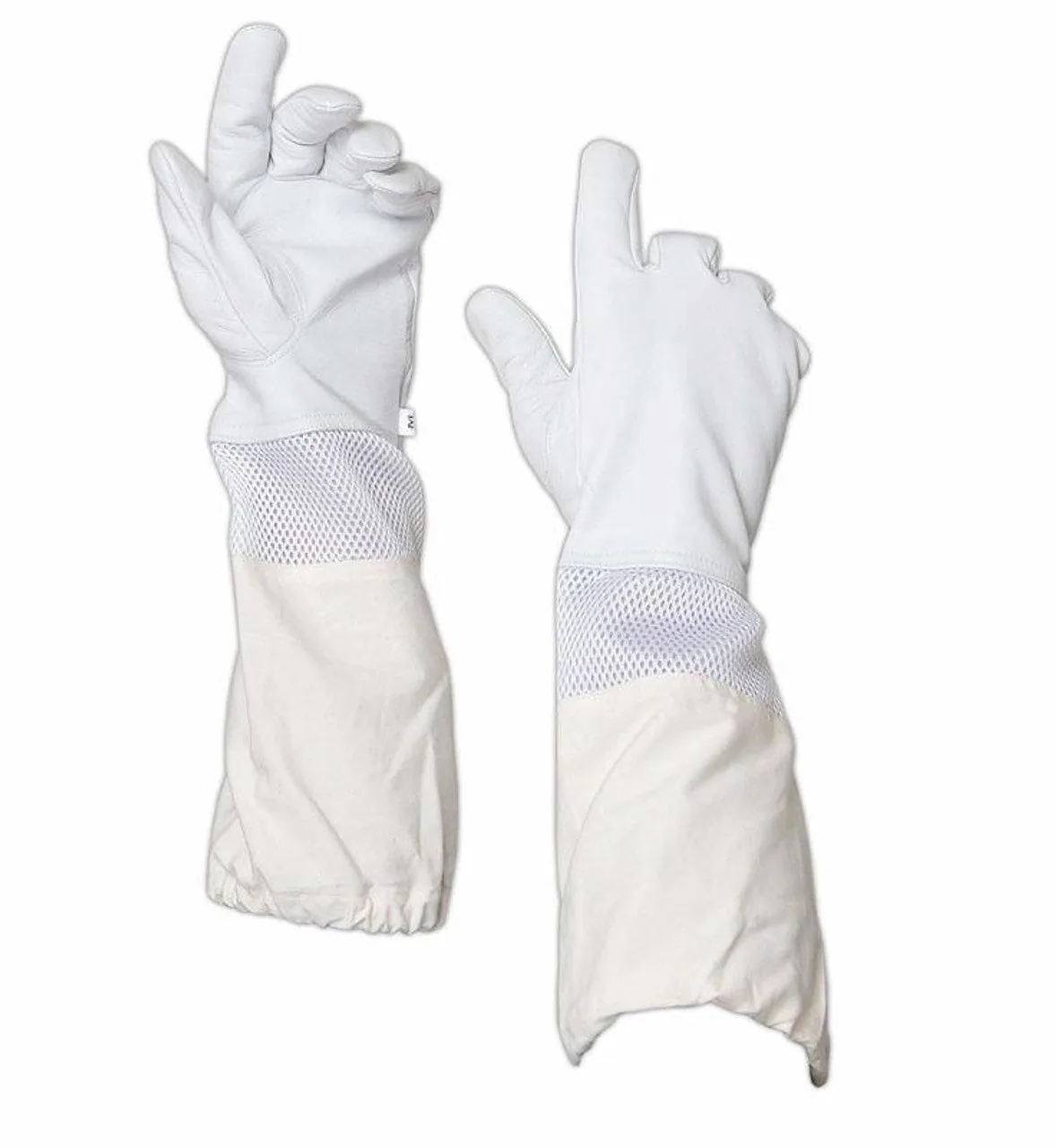
Which material for children's beekeeping gloves
| Material | For a child |
|---|---|
| Nitrile | Best dexterity, cheap, easy to size down, and disposable when they outgrow them. The usual right answer for a first season. |
| Goatskin | Thin for leather and softens well. Good once a child is handling frames regularly. |
| Cowhide | Too stiff and too thick. A child cannot work in it. |
Nitrile's drawback — less protection against a determined sting — matters less than it sounds for a child who is watching and passing tools rather than working a colony over. Nitrile versus leather sets out the trade for an adult; weight dexterity higher for a child and the answer moves.
What a child can do, and when
No age answers this, but the jobs go in a rough order and the gloves follow it.
Watching, at a distance, in a veil. No gloves needed. This is where everyone starts and it can last a whole season without anybody minding.
Carrying and passing. The brush, the tool, a spare box. Gloves from here, because hands are near the hive even if they are not in it.
Holding a frame with an adult's hands on it too. Where dexterity starts to matter and a badly fitting glove starts to cause problems.
Lifting a frame alone. Only once they are calm, slow and asking to. The smoker stays with an adult for a long time after this point — it is a lit fire, which is a different risk from the bees.
The gauntlet, and the suit
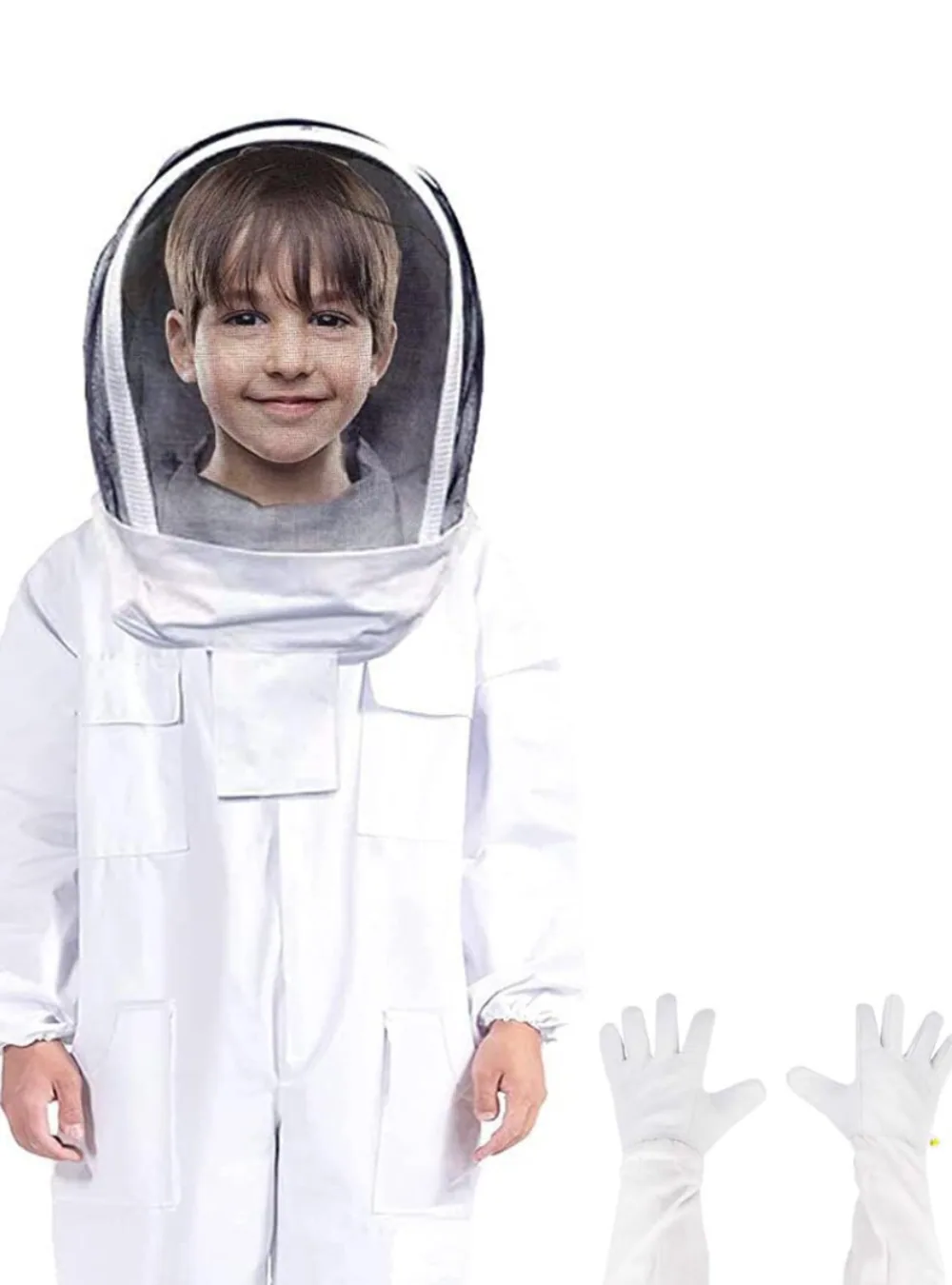
The gauntlet needs to tuck under the suit's cuff with enough overlap that it stays covered when the child reaches forward. Children reach, crouch and twist far more than adults do, so the overlap gets tested more.
If the suit's own cuff is loose, no glove fixes it — that is the suit being too big, which is the commonest fault in children's kit and the reason the children's suit guide argues so hard against buying two sizes up.
Checking children's beekeeping gloves when they arrive
- The child can pick a coin off a table wearing them.
- They can open and close the veil zip in them. If not, the gloves come off at the worst moment.
- The cuff sits under the suit's sleeve with several centimetres of overlap.
- Nothing bunches when they make a fist.
- They can hold a hive tool and actually turn it.
That first test is the one worth doing. A child who cannot pick up a coin cannot handle a frame, and will either squash bees or give up.
Teaching the hands, not just the kit
Two habits do more than any glove.
The drill, first. A bee inside the suit means walk away, not swat.
Slow hands. Everything near a colony is done slowly — lifting, turning, putting down. Fast movement is what a colony reacts to, and it is the thing children do naturally.
Look before you put anything down. Most crushed bees are crushed by a frame lowered onto them, not by fingers. A child who checks first has learned the single most useful piece of hive craft there is.
Neither needs a glove. Both make the gloves work better. If you are looking for somewhere for a child to learn that is not your own hive, Cornell’s Pollinator Network and the University of Georgia Bee Program run the sort of outreach worth finding in your own region.
Sharing, and hygiene
Children's beekeeping gloves are the one item in a family or club kit that is genuinely awkward to share. They hold sweat, they do not wash well, and leather in particular moulds to one hand.
For a household, one pair each is worth it even though they will be outgrown. For a group that has visitors, the cheap disposable option is the honest answer: a box of nitrile in two or three sizes costs little, fits better than a shared leather pair ever will, and removes the question entirely.
If gloves must be shared, let them dry fully between users and keep them out of a sealed box. Buying for a club covers the same problem across the whole kit.
Replacing children's beekeeping gloves
Expect to, and more often than the suit — and clean them between times. Hands grow, nitrile perishes, and leather on a child gets soaked and stiffened faster than on an adult because children are less careful with it.
Buy cheaply and replace willingly rather than buying one good pair to last, which ends up being a pair that fits for one season and is unusable in the next two. Gloves are the consumable in a family kit — what a family actually needs sets out which parts of a kit are shared and which are not.
When a child needs gloves at all
From the first visit where they will be close enough to touch anything. Watching from several metres away in a veil does not require them; standing at the hive does.
The test for whether a child is ready to be at the hive at all is not about kit: it is whether they can follow an instruction they do not like, immediately and without arguing. Gloves do not substitute for that.
Our beekeeping gloves are listed by hand size, and the children's suits are cut as their own garment rather than graded down from adult patterns.