
Bee suit fabric: what are they made of?
Three materials cover almost everything on the market — woven poly-cotton, bonded ventilated mesh and lightweight ripstop — and they fail in different ways.

Almost every bee suit fabric on the market is one of three things: woven poly-cotton, bonded multi-layer mesh, or lightweight ripstop. Veils are a fourth material again — usually a stiffened polyester or nylon mesh. Each stops a sting by a different mechanism, and knowing which is which tells you more than any weight figure on a listing.
The three bee suit fabrics you will actually meet
| Fabric | How it stops a sting | What it costs you |
|---|---|---|
| Woven poly-cotton | By being loose — slack cloth held away from skin | Heat. It is a sealed garment. |
| Bonded ventilated mesh | By structure — layers held apart by a springy middle | Bulk, and it snags more easily |
| Ripstop | By being loose, like poly-cotton, in a lighter cloth | Less margin. Thin and packable rather than tough |
The first column is the one that matters. A sting reaches a few millimetres, so every bee suit fabric works by holding its outer face further away than that — and they differ in whether the distance survives you leaning on it.
Poly-cotton, the traditional one
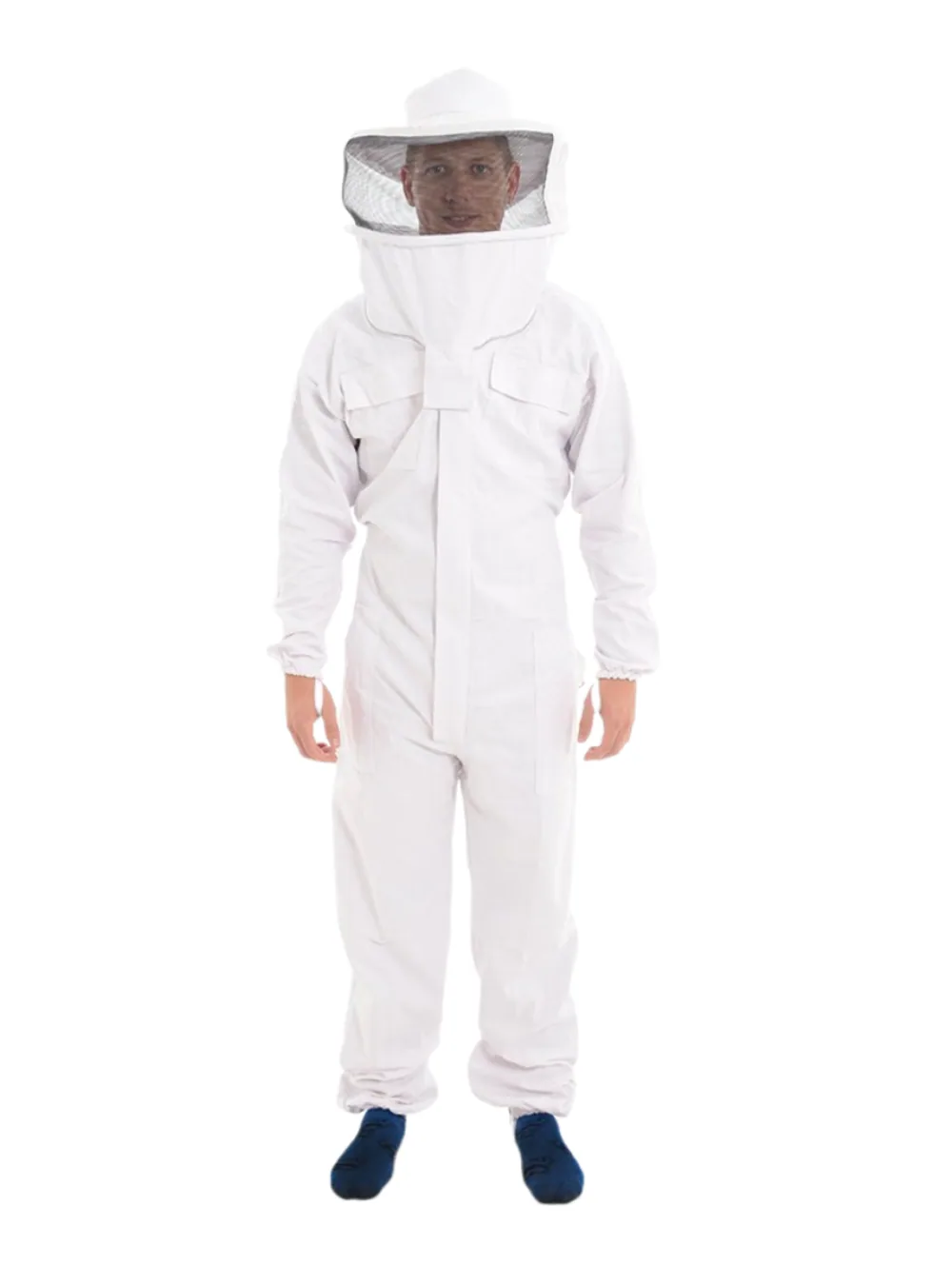
A woven blend of polyester and cotton, and plain weave or ripstop is the next question within it. It is the oldest answer still in use and it remains a good one.
Cotton in the mix makes it quieter against hive furniture and more comfortable in the heat than pure synthetic. Polyester makes it stronger, faster drying and far less prone to shrinking. The blend is a compromise that has survived because it works — polycotton versus cotton covers how the ratio changes it.
Its weakness is the one every sealed garment has: no airflow. On a hot afternoon a poly-cotton suit is a tent, and a suit you are too hot to keep closed protects you from nothing.
Bonded ventilated mesh
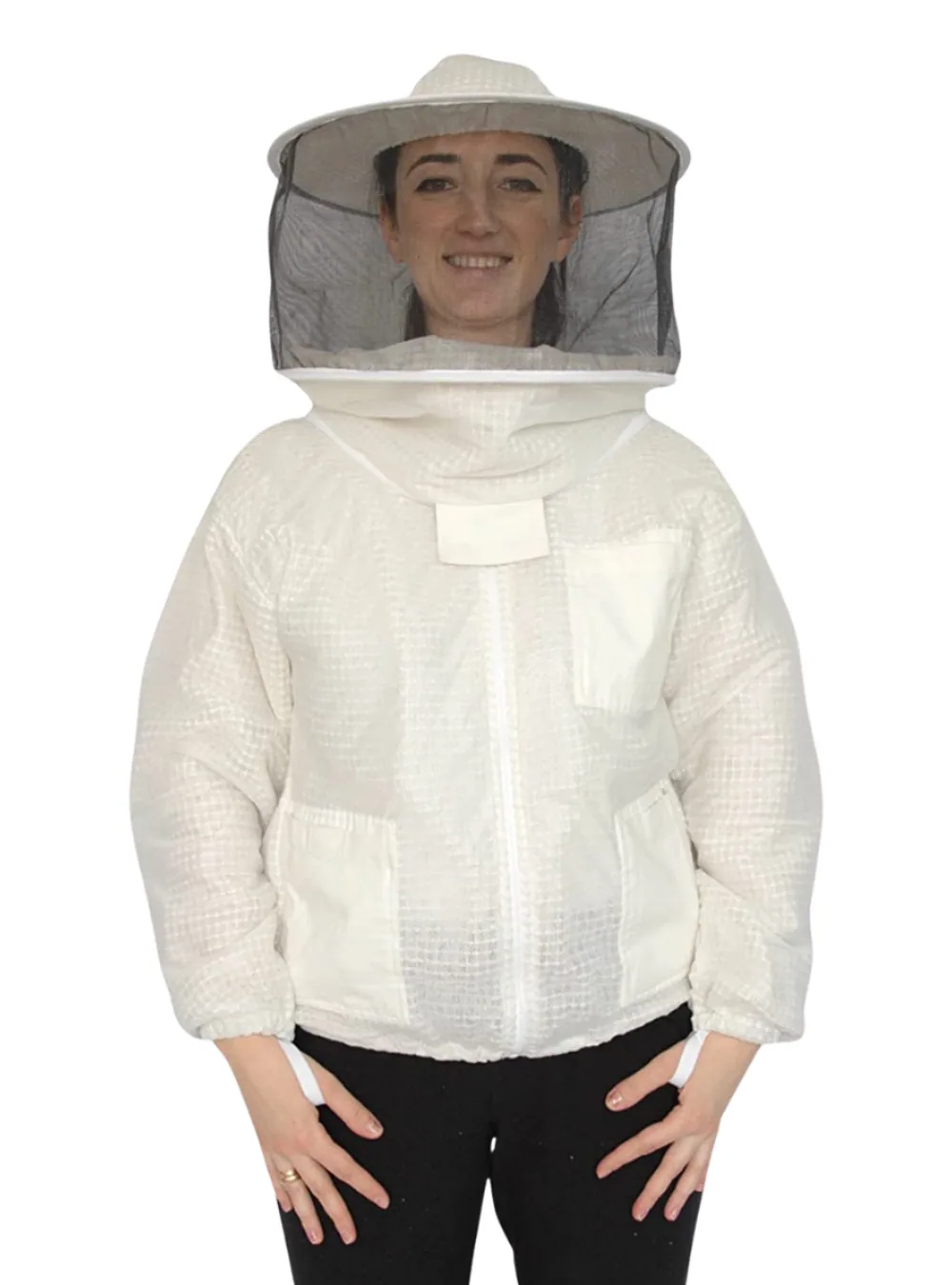
Two mesh faces with a springy open layer bonded between them. The middle layer is the whole point: it holds the outer face clear of your skin and keeps holding it when you lean on a hive.
That gives you two things at once. Air moves through the gap, so you are cooler. And the gap survives compression, so you are harder to sting in exactly the positions where a woven suit fails. Three-layer versus two-layer mesh covers how much the middle layer varies between makers.
Its weaknesses are snagging and heat damage. Mesh catches on thorns and nails, and a tumble dryer or a hot wash softens the bonding until the layers flatten — at which point the bee suit fabric looks identical and protects like a single layer. Washing it cool is not fussiness.
Ripstop
A light woven cloth with a reinforcing grid woven in, so a tear stops at the next thread rather than running. It is what makes lightweight suits possible.
It protects the same way poly-cotton does — by being loose — with less cloth to do it, so there is less margin where the garment is pulled tight. The trade is weight and packability, and for a quick inspection in mild weather it is a reasonable one.
What veils are made of, and why it is not bee suit fabric
Not the same material as the suit, and the difference is deliberate. Veil mesh is a fine stiffened polyester or nylon, woven open enough to see through and stiff enough to hold its shape away from your face.
It is also dark at the face panel, which is an optical decision rather than a material one — black threads absorb light instead of reflecting it into your eye. Veil mesh is the part of any suit most likely to be damaged, which is why being able to replace it matters more than what it is made of.
The parts that are not the main cloth
A suit is four materials, not one, and the other three decide more about its life than the body fabric does.
- Thread. Polyester on anything worth buying. Cotton thread rots, and a seam that fails is a bigger hole than a snag.
- Elastic. At cuffs, ankles and sometimes the waist. It loses its recovery to heat and ultraviolet, and it is the first thing on any suit to fail.
- Zip tape and teeth. Usually nylon coil on hoods, moulded plastic on fronts — zipper types and failures covers the difference.
- Veil mesh. A different material again, and the one most likely to be damaged.
None of these appears in a fabric specification, and all four end more suits than the body cloth does.
Why the same bee suit fabric is cut differently
A material behaves differently depending on how the garment is drafted, which is why two suits in identical cloth are not the same suit.
Woven poly-cotton needs generous cutting, because the slack is the protection. A fitted poly-cotton suit is a worse garment than a loose one in lighter cloth.
Bonded mesh can be cut closer, because the standoff comes from the structure rather than the drape. That is why ventilated suits often look trimmer without being less safe — and why a ventilated suit that has been flattened is suddenly far more dangerous than a flat woven one, since it was relying on the gap.
What bee suit fabric does not tell you
Three things people expect it to, and it does not.
How long the suit lasts. Cuffs, zips and veils end suits; the body cloth almost never does. How long a suit lasts turns on storage and laundry rather than material.
How well it fits. A badly cut suit in excellent cloth is a badly cut suit, and fit is what decides whether the fabric is doing its job at all.
How sting-proof it is. There is no standard test, so any number you are quoted was chosen rather than measured.
What to ask instead of "what is it made of"
- How many bonded layers? On a ventilated suit this is the real question. One is not ventilated construction whatever the listing says.
- Does the mesh spring back? Press it between finger and thumb. Springy is working; flat is not.
- Can I buy a replacement veil? It decides the suit's working life.
- Is it machine washable, and at what temperature? Cool-wash-only is normal and worth knowing before you buy.
You will notice none of those is a number. That is deliberate — see what GSM actually tells you, which is less than it appears.
Which bee suit fabric to buy
If you work anywhere warm, ventilated mesh, and the margin is large rather than marginal — larger again in humid climates. If you keep a couple of hives in a mild climate and inspect in the morning, poly-cotton is cheaper and perfectly sound. Ripstop is for people who want something light to carry and do not need much margin.
Ventilated versus cotton is the decision in full, and what beekeepers wear is the wider kit list if you are starting from nothing.
For guidance on protective clothing from somewhere with nothing to sell, Penn State's beekeeping basics and the University of Georgia Bee Program are the right sort of source. Ours are grouped by construction: ventilated suits and cotton and poly-cotton.